Taxation Without Representation (Again)
Virginia is a fascinating state, or commonwealth, if you want to be specific. It was the first landing point for New World colonists and became the first colony shortly thereafter. It was called home for some of our nation’s most influential men, including Thomas Jefferson, James Madison, and George Washington. The Constitution and the Declaration of Independence were written by Virginians, and the framework for a bicameral Congress was originally known as the “Virginia Plan.” The commonwealth would also become infamous as the seat of the Confederacy in 1861 and would subsequently host numerous brother-on-brother bloodbaths during the civil war.
Harkening back to its glory days, the Old Dominion is in the news once again, and once again it is because of significant political upheaval. As many of you know, Virginia recently voted for a redistricting plan that would see its current 6-5 Democrat/Republican split into a 10-1 split. The final referendum vote came out as 51% in favor, 49% against, meaning that 51% of the state voted to give themselves (and remove from the rest) 90% of the electoral power that Virginia has in the House of Representatives.
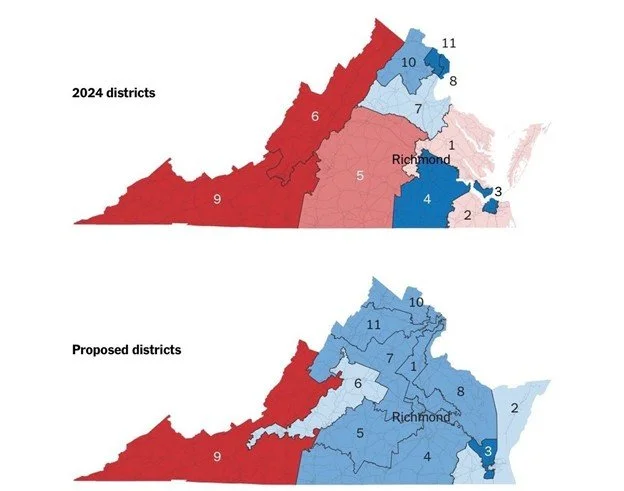
Much ado has been made of this flagrant power grab, so I will not be rehashing its importance here. Instead, I want to use this moment to measure where we are as a nation. While everyone consciously knows that modern America doesn’t resemble our founding, I think it will surprise you very much to see how far we’ve come and what truly is at stake. Virginia’s gerrymander is much, much worse than it seems on the surface. In exploring this 250-year shift, I hope it will become clear where also we are heading.
First, a history lesson. It is a common refrain that America was founded on rebellion against taxation. While this is almost true, it misses the larger point. America was founded against taxation without representation. Lack of representation was much more significant to the founders than the amount of taxation in the first place. It is another common refrain that the British taxed American colonists to pay for sums accrued defending the colonies in the Seven Years War. This is partly true but again misses the point in that Britain primarily taxed the colonies to assert its authority that it had the right to do so. The assertion of authority over the colonies was more important than the taxation itself. In sum, the revolution was nominally over the British belief that it had the authority to tax the colonies without granting them representation, and the colonists vehemently insisting that this was a violation of their rights.
We begin with the Sugar, Stamp, and Townshend Acts, which are largely considered the beginning of the American Revolution. These duties were levied on ship-born imports upon arrival at a port and were applied to sugar, stamps, paint, paper, lead, glass, and yes, tea. The tea tax under the Townshend duty was 3 pence per pound, or $5.45 per pound today. After wholesale and retail markups, the average colonist would end up paying roughly 6 pence, or almost $11 today, per pound of tea. Glass was taxed at 4 shillings and 8 pence per 100 pounds, or roughly $10 per pound today.
Remember; the Magna Carta had codified the sentiment that taxation was a gift given freely by the people, through their common consent, and could not be arbitrarily required by any authority. In 18th century England, this common consent could only be given through a representative in Parliament, which the colonists did not have. This is the crucial lynchpin of the entire revolution. By 1763, the colonists had been operating under the Molasses Act of 1733 for thirty years, which levied a 6 pence per gallon tax on sugar. The crown saw hardly any of this levy as the colonists simply smuggled sugar for free. The crown had no way of enforcing collection either; it would have cost them more to pay men to collect the levy than they would have received from it in the first place. Instead of enforcement, the crown sought to compete with smugglers. The Sugar Act of 1764 cut the levy from 6 to 3 pence and moved smuggling trials away from a jury of American peers and replaced them with a singular judge in Nova Scotia where the defendant was legally presumed guilty and had to prove his innocence.
Due to non-importation agreements (boycotts) by colonists and the lack of revenue, the Sugar Act was repealed, but hostility over the act remained. For a reason that seems inexplicable, the crown would try this method again with the Tea Act of 1773, in which they allowed the East India Company to sell tea directly in America without stopping in England first, as was the prior regulation. This permission removed England as a middle man in the tea trade, which meant the tea wouldn’t be marked up as it passed through England, which made it cheaper, not more expensive. Even though the Townshend act had been repealed in 1770, King George III insisted that the tea duty remain to establish sovereignty over the colonists. Even with the 3 pence tea duty still in place, English tea was much cheaper than it had been in preceding years. This made the East India Company an effective monopoly that would destroy American tea traders. The 3 pence payment also went directly to governors who worked for the king, not the colonial merchants. These reasons, while important, are not directly what led to the Boston Tea Party. The most important issue, as was widely decried by Samuel Adams, was that by paying the tax, the colonists would implicitly agree to the concept that the crown could tax the colonists without representation in parliament. In reality, the Boston Tea Party and the American revolution were started by tax cuts, not tax hikes. Of course, the price of taxation mattered. If it didn’t, they wouldn’t have smuggled goods for decades. However, the main issue was taxation without representation, not the dollar amount of the taxation.
In late 1773, three ships—the Dartmouth, the Eleanor, and the Beaver—arrived in Boston Harbor. Under British law, a ship had 20 days to unload its cargo and pay the duties. If the duties weren't paid, the cargo would be seized by customs officials and sold at auction (which would still result in the tax being paid). On the night of December 15, 1773, the Sons of Liberty boarded the Dartmouth and threw 342 chests of tea into Boston Harbor. The destroyed cargo would have been worth $4.2 million today. In response, Britain established what would become known as the Intolerable Acts. These acts closed Boston Harbor until the tea debt was repaid and abolished the election of local council members, instead replacing them with crown appointees. Trials for British government officials were to be held in England instead of the colonies, and colonists were required to quarter soldiers in their homes. This not only meant providing them with lodging, but also basic life necessities such as candles, food, stamps, and more. Functionally, the Intolerable Acts equated to a military occupation and suspension of basic legal expectations. According to Jospeh J. Ellis, author of The Cause: The American Revolution and its Discontents, the intent of these acts was not only to punish Boston, but also to show the other colonies what would happen if they followed suit. Instead, the establishment of the Intolerable Acts had the opposite effect; it galvanized the colonies together and began to form a separate American identity instead of British.
Stick with me. I know this is a lot of information, but it becomes relevant to Virginia gerrymandering today. Before we move on to today, we must explore one last facet of British governance that brings all these issues together.
The decision of the crown not to grant the colonies representation makes any student of history’s head swim. The formal reason was that England operated under a system of ‘virtual representation.’ The British Parliament argued that cities like Manchester and Birmingham, and Boston or Philadelphia by extension, were "virtually" represented because every member of parliament was supposed to act for the good of the entire empire, not just their local district. If King George III gave Boston or Philadelphia seats because they were "taxed without representation," he would have logically been forced to give seats to Manchester, Birmingham, and every other unrepresented town in England. This would have required a total parliamentary reform, which the ruling class feared would strip them of their own power. By using virtual representation, the King could arbitrarily hand out favors to wealthy, or otherwise aligned, representatives to consolidate power (precisely what is happening today). This is why American revolutionaries were dogmatic in mandating district and state representation and why we have a House, Senate, and an electoral college; Do not lose sight of the importance of this as we continue.
Why Does This Matter?
The 2026 Virginia gerrymander is egregious in that it is disenfranchising roughly 49% of its own constituents. Not only is this cause for concern on its own, but Virginia has also joined the National Vote Compact, along with California, Colorado, Connecticut, Delaware, District of Columbia, Hawaii, Illinois, Maine, Maryland, Massachusetts, Minnesota, New Jersey, New Mexico, New York, Oregon, Rhode Island, Vermont, Virginia, Washington. The National Vote Compact awards all of each state’s electoral votes to whichever candidate wins the popular vote, thus dismantling the electoral college. Compact states now comprise 41% of all the country’s electoral college votes. They only need 51% to upend the system permanently. Additionally, the redistricting in Virginia could not have happened without Virginia Democrats flagrantly violating the law. Not only did they hold a special session open for two years; they also purposefully wrote the referendum in an incredibly misleading way and did so despite Virginia having a law that explicitly bans partisan gerrymandering. The Attorney General, now arguing this case, previously openly called for the death of Republicans and was still able to win his election--we will not be holding our breath to see how the case turns out.
The upending of our institutions clearly shows that many have forgotten (or simply do not care) why we established those institutions in the first place. The fact that this rejection of history is so evident also shows something else: the proponents of removing precedence give little credence to our political inheritance and simply do not care for upholding the existing system in any way. In essence, it is a complete political occupation. Let’s look at a few examples.
Massachusetts: 36% Republican voters, 0 Republican House Seats.
Connecticut: 42% Republican voters, 0 Republican seats.
Maine: 46% Republican voters, 0 seats.
New Mexico: 46% Republican voters, 0 seats.
New Hampshire: 48% Republican voters, 0 seats.
Rhode Island: 42% Republican voters, 0 seats.
Vermont: 32% Republican voters, 0 seats.
Hawaii: 38% Republican voters, 0 seats.
Delaware: 42% Republican voters, 0 seats.
Maryland: 40% Republican voters, 1 seat (12% of total seats).
California: 40% Republican voters, 9 seats (17%).
In fairness, many of these seats are At Large, meaning they only have one seat that can’t be split. However, were their population to grow, it’s unlikely that the state legislatures would allow a second district to go to Republicans. Again, in fairness, many red states have significant Democrat populations that have zero representation, like Alaska, Arkansas, Iowa, Idaho, Montana, Nebraska, North Dakota, Oklahoma, South Dakota, Utah, West Virginia, and Wyoming, whose populations vote for Democrats roughly 25-45% of the time.
There’s a major difference between the two, however. Aside from Republicans not seeking to upend the electoral college, Republicans also have definable communities within states that Democrats do not.
Compare the map below to the Virginia district map above.
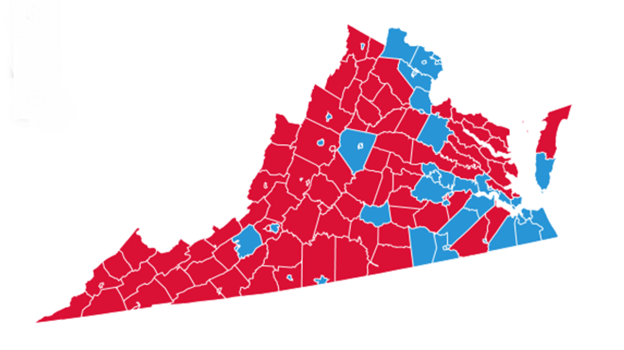
This is how each community in Virginia votes by county instead of by district. Which map at the beginning of this article looks most similar to this one?
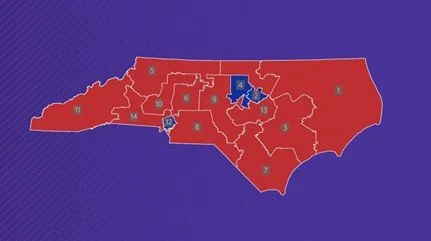
The Democrats’ fatal flaw is that they don’t understand that states, and nations as a whole, are not just a conglomeration of random people, but are made up of like-minded communities that act as independent agents. The pre-gerrymandered Virginia map tracks very closely to the county map because it tracks real, not theoretical, communities of people who hold real beliefs, have real cultures, and generally strive to reach the same goals. This is why, for example, North Carolina’s districts look the way they do. Despite 48% voting for Democrats, North Carolina’s Democrats all roughly live in cities, which means they have a lower percentage of house seats as a result. If 48% of your voters are condensed into tiny cities, you will have districts that represent that. Additionally, many districts that appear blue, in Virginia, North Carolina, and across the U.S., only appear that way because of colleges. These are not permanent residents and skew data to make some counties look bluer than they are.
This is why Democrats push so hard for the National Compact vote – their power is significantly diminished by using district-based representation, but they put zero effort into understanding why the system was built this way in the first place. The common refrain of Democrats is “land doesn’t vote,” meaning empty land shouldn’t have the same weight as dense population centers. This, however, is incorrect. The founding fathers intentionally designed a system where states – not individuals – are the primary agent in elections. If individuals and raw populations were intended to be the primary agent in our political system, they would never have invented the Senate or the Electoral College, both specifically designed to reduce the influence of population centers.
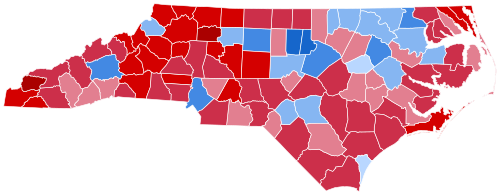
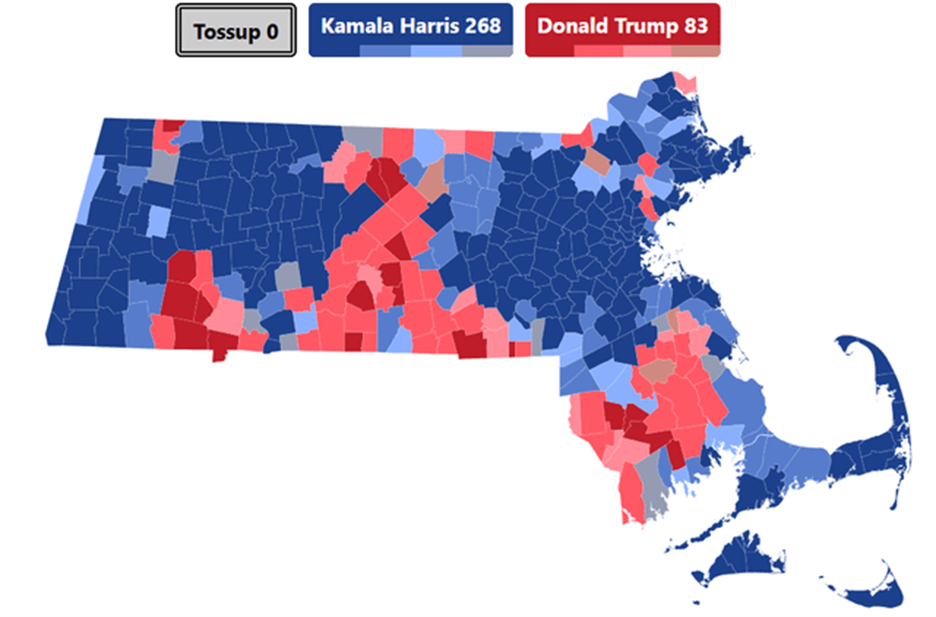
Red states that don’t exhibit higher numbers of Democrat districts do so because their Democrats are centralized into tiny communities that cannot constitute numerous districts, or spread apart so far that they cannot constitute a identifiable community. The same is not true in reverse. Massachusetts, for example, has very clearly definable Republican areas that could easily constitute Republican districts but are given zero representation. Donald Trump won 82 counties in the 2024 election, but the state continually puts forth zero Republican districts, even though you can see where they could easily be placed on the county map.
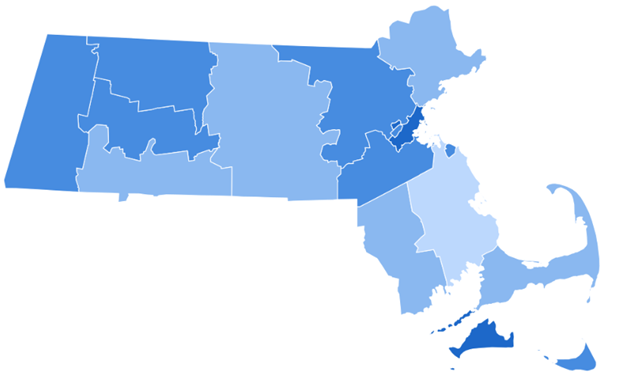
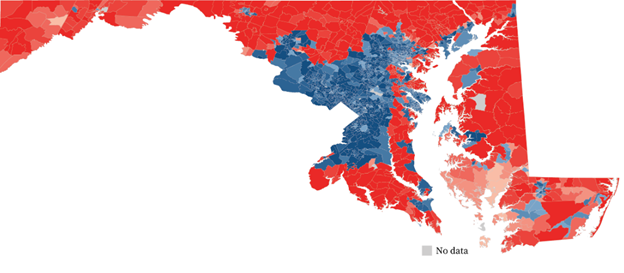
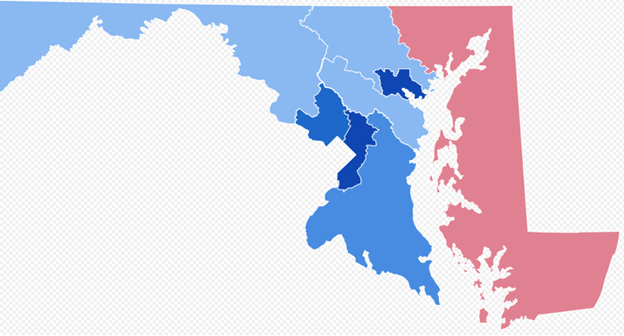
Maryland is perhaps the most egregious. Look how much red there is in Maryland as opposed to the way districts are drawn.
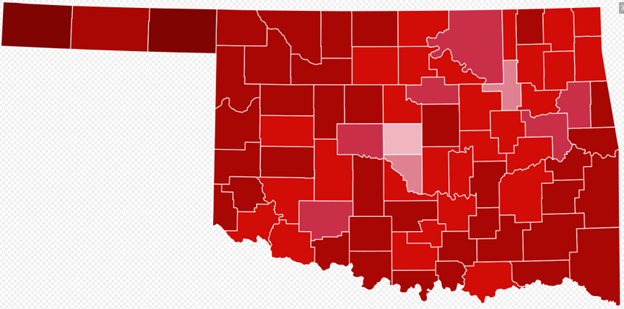
Again, it cannot be stressed enough that this is not true in reverse - 31% of Oklahoma voted for Kamala Harris in 2024. Can you show me on the county map where the Democrat stronghold is for Oklahoma, and where districts should be drawn for them?
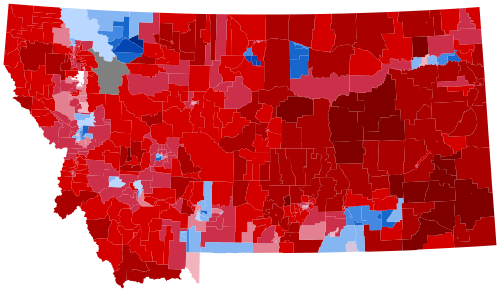
Even Montana, which has real Democrat pockets but only receives two districts, can’t reliably draw a Democrat only district. Republicans do not draw Democrat districts because they geographically cannot. Democrats do not draw Republican districts because they cannot win if they do.
The reason our entire system is based on districts is because they represent real and complex communities. American colonists rejected virtual representation because they didn’t have a say in Parliament without pro-colonist representatives advocating for their rights, and a politician in London certainly wouldn’t advocate well for a Bostonian. This disconnect is why Virginians today are furious that a representative in Fairfax now represents someone as far away in Virginia as New Jersey is to Virginia. Virginians are being virtually represented by people who not only don’t represent them, but openly hate them.
What about the taxes?
We’ve established that, as Democrats pursue unashamed gerrymandering and National Vote Compacts, the average American loses representation both in Congress and the White House. Now, let’s look at what that means for you. According to Alvin Rabushka in Taxation in Colonial America, the average colonist in 1775 paid roughly 1-2% of their total income in taxes. This is a cumulative total, not just an equivalent of federal taxation. Today, the average American pays somewhere between 26-32% of their total income on federal, states, sales, county, excise, and other taxes. In order, you pay federal (12-15%), employment (Social Security, Medicare, 7.65%), state and local (3-5%), sales (2-3%), gas tax (1%), and tariffs (1.5%). Percentages here show portion of income. Of course, this is the price we pay for public goods such as schools, roads, and libraries, right? Except that it’s not. The colonists also had schools, roads, and libraries. Today, only roughly 15.6% of your tax burden goes to schools, roads, and libraries. If you don’t own real estate, that number is significantly lower (barely 3%) as most of those taxes are property taxes which fund schools. The other 85% of your tax burden goes primarily to a failing social security system, Medicare/Aid that is rampant with fraud, and a military that has not passed an audit for eight years in a row. Likewise, many people would argue that our schools are failing, roads are terrible, and libraries are leftist bastions of indoctrination.

Arlington County, Virginia.
It gets worse. Everyone is familiar with the common complaint that you are taxed when buying a car, taxed to register it, taxed every year to inspect it, and taxed every time you fill it up, but there are even worse taxes. In Virginia, South Carolina, Mississippi and Wisconsin, you must pay a quarterly garage fee simply to own a vehicle. In Seattle and Philadelphia, you pay a 1.5 cent per ounce tax on soda. In Maryland, you pay a tax to own a driveway or patio. In Iowa and Pennsylvania, your property taxes don’t pay for street lighting or stormwater control. Those are billed separately. In Chicago, there is literally a 9% tax on doing fun things, unbelievably called an amusement tax. Maine has a 5.5% tax on streaming services. Hawaii has a weight tax on vehicles. New York has a tax simply for driving during rush hour, as if anyone wanted to be doing that in the first place. Shockingly, New York even taxes you for trying to not look ugly. Yes, they have a 4.5% ‘grooming’ fee for barbers and beauticians. California has a tax if your income exceeds $1 million, adding a 1% "Mental Health Services" tax on top of its already high 13.3% top income bracket.
My favorite example of American taxation comes from Fairfax county, Virginia. Fairfax County residents – twice – rejected a public proposal to institute a tax on prepared meals. Did the county legislature listen to the will of the people? Of course not. The meals tax was voted on by the county and came into effect on January 1, 2026.
Let us be clear on where we currently stand; you pay a tax rate over 3000% higher than the American colonists did and you have roughly the same amount of representation, which, for many of you, is none. Progressives will continue to remove your representation and be honest about the fact that they are doing so. Your taxes provide you nothing and the people taking them from you in ever-increasing amounts will continue to erode our electoral institutions with impunity. Your county, state, and federal representatives have levied taxes upon you that your forefathers quite literally would have murdered to prevent. The colonists rebelled over a taxation rate of 1% on essential items because they had no parliamentary representation. You are taxed 30% to pay for geriatric homeowners, failing government programs you will never use, and never-ending billion dollar defense contracts while your districts and electoral votes are taken away from you right in front of your face.
Where does this lead?
It’s easy to tell what will (or at least, could) happen naturally if we don’t change course. In 1765, Thomas Hutchinson served as both the Lieutenant Governor of Massachusetts and Chief Justice of the Superior Court. Hutchinson’s brother-in-law, Andrew Oliver, had been named Stamp Master when England had recently implemented the Stamp Tax. Believing that a new building built by the docks would be Oliver’s new headquarters for Stamp enforcement, a mob levelled it to the ground. Hutchinson himself was thought to be complicit in the Stamp Act’s passage. When a mob formed in front of his house, they required Hutchinson to publicly denounce that he had supported it. He refused. In return, the mob ransacked his house and tore it down by hand; no small feat considering the palatial size of the house.
In 1768, When John Hancock’s ship The Liberty was seized, a mob cornered customs collectors and pelted them with stones. In almost every major city, Sons of Liberty members would create effigies of local officials, with their name and likeness, and then burn or hang them in the town square. Mobs would often corner officials in their houses and refuse to leave until that official resigned their post. In 1772, Rhode Island colonists boarded and burned the HMS Gaspee, a British customs schooner that had been enforcing trade regulations, after it ran aground.
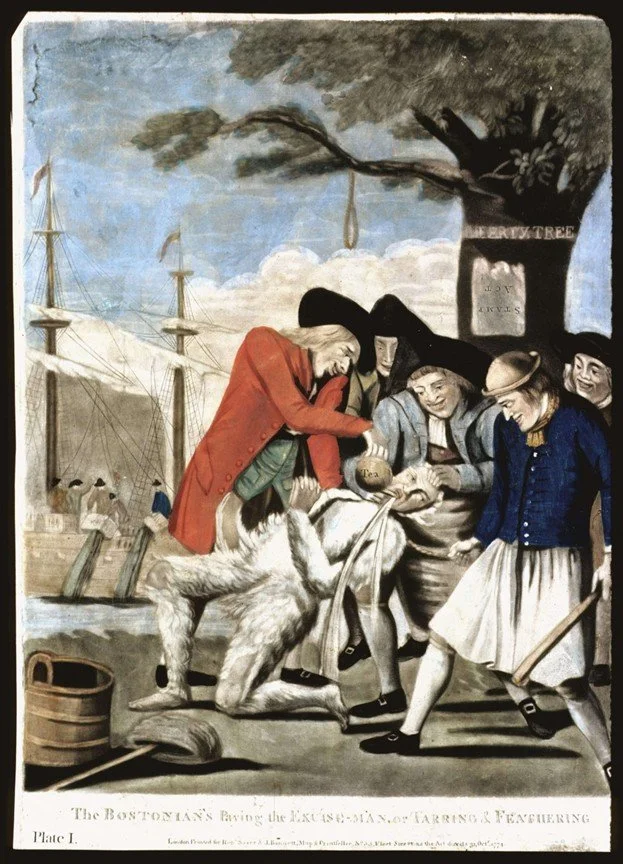
Perhaps the most famous punishment was tarring and feathering. In 1774, John Malcolm, a British customs official, was seized by a Boston mob, stripped, covered in hot tar, and coated in feathers. He was then paraded through the city and was threatened with having his ears cut off unless he cursed the King. In East Haddam, Connecticut, Abner Bebee spoke out against the patriot’s cause. He was tarred and feathered, taken to a hog sty, covered in dung, and had hog dung smeared into his eyes and mouth. Thomas Randolph from Quibbletown, New Jersey, was targeted for publicly opposing and mocking the local patriot committees. He was stripped naked, coated in tar and feathers, and paraded around town in a wagon until he begged for forgiveness and promised to support the Patriot cause.
While these examples are anecdotal, disagreements over electoral politics often became much larger and much more violent. In 1854, Kansas and Nebraska were to be admitted to the Union. Instead of designating them as slave or non-slave states, the choice would be left up to the residents of the newly-formed states. Between 1854-1859, thousands of people swarmed Kansas in a type of reverse-gerrymandering intended to sway whether or not the state would own slaves. The violence that followed was brutal and became known as Bleeding Kansas. There were raids, assaults, and murders – somewhere between 50 and 200 people lost their life in an attempt to sway local electoral politics in one state alone. Were the same thing to happen today, it would be much worse.
In fact, there’s an entire state that exists today that was created simply to avoid a war altogether. The compromise of 1820 was enacted to carefully keep the balance of free and slave states. Missouri, being added to the Union, was a southern state that very obviously intended to be a slave state. If allowed, this would have tipped the balance of slave vs. free states in the slave owner’s favor. This was a cause worth going to war over for the North. To keep that from happening, Maine was also admitted to the Union as a free state. This kept a delicate but uneasy balance for another 40 years.
Of course, electoral politics were the cause of the civil war in 1862. As Lincoln stated: “If there be those who would not save the Union unless they could at the same time save Slavery, I do not agree with them. If there be those who would not save the Union unless they could at the same time destroy Slavery, I do not agree with them. My paramount object in this struggle is to save the Union, and is not either to save or destroy Slavery. If I could save the Union without freeing any slave, I would do it, and if I could save it by freeing all the slaves, I would do it, and if I could save it by freeing some and leaving others alone, I would also do that.” The very makeup of our citizenry, and what it would mean for state electoral power, was one of the straws the broke the camel’s back and led to civil war.
The Dust Bowl shows us this as well. The demographic shift that followed the mass migration transformed numerous states into political battlegrounds, as the influx of impoverished, white, Southern and Midwestern laborers brought a distinct brand of New Deal-style populism that initially strengthened the Democratic coalition's grip on the region. However, this migration also planted the seeds for modern Republicans. Midwestern people carried with them deep-seated evangelical traditions and individualistic social values that would eventually collide the urban, liberal wing of the Democratic Party. This caused massive social upheaval at the time.
The point of these examples is to illustrate that electoral politics in America are not a joke. Historically speaking, they’ve been the cause of secession movements, mass migrations, murders, and wars, and it is foolish to think that cannot happen again.
To Ponder, Going Forward
21st century America is one in which very few people have adequate representation at the local, state, or federal level. It is also characterized by rampant and frivolous taxation, wasteful expenditures, and a complete disregard of public sentiment. We pay more in taxation than our forefathers ever could have conceived of, and we allow the blatant dismantling of the institutions that our forefathers bled and died for.
We’ve often talked about the notion that multiculturalism is actually a weakness for the United States, and that diversity is not a strength. While we will not rehash that argument here, but it has become clear that the United States is not one country; it has not achieved E Pluribus Unum. In practice, it is at least two different states fighting for control of the same cultural and political space. One side values tradition, inheritance, and consistent rules. The other simply does not. Take a look at the racial breakdown of the redistricting vote and ask yourself if this is what a homogenous, well-blended society looks like, or if it looks more like two armies competing against one another.
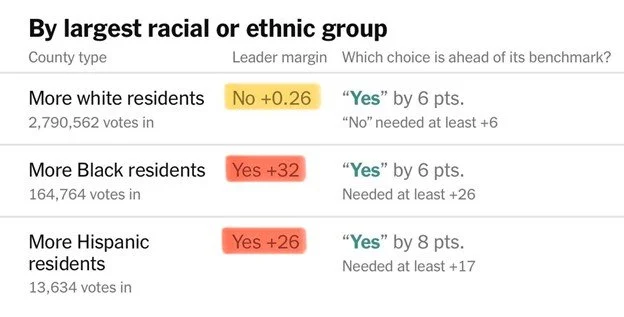
Just as American as you or me, or something.
I encourage you to ask yourself other questions as you contemplate the veracity of this argument: Do you feel like Congress generally acts in your best interest? Do you feel like you are taxed fairly and receive what you pay for in taxes? Do you feel that your government is working effectively and efficiently? If the answers are no, then I encourage you to think critically about what needs to be done to ensure that the answers are yes.