
Lessons Learned from the Indian Removal Act
On June 11, 1864, Nathan Hungate and a hired hand rode out into Colorado territory looking for lost heads of cattle. Hungate had recently accepted work out west as a ranch hand and had moved his family out with him. After some time out on the plains, they looked behind them and saw black smoke coming from the direction of Hungate’s house. Fearing an Indian attack, the hired hand told Nathan that his family was likely already dead and that he and Nathan should ride for Denver to escape the same fate. This fear was well-founded - for years, settlers in the Colorado territory had been subjected to countless raids, murders, and skirmishes by Cheyenne and Arapaho bands. Hungate elected not to ride to Denver and instead rode back to save his family, which included his wife Ellen, in her late twenties, daughter Laura who was almost three, and daughter Rosa, a six-month old infant. Upon reaching his house, his worst fears were confirmed. His house had been lit on fire and his entire family had been brutally slaughtered. His wife had been raped, scalped, and had her throat slit before being dumped into a pit. His two year old daughter had her throat slit so badly that she was nearly decapitated, and his six-month old daughter had suffered the same fate. Most disturbingly, either the daughters had to watch their mom raped and scalped, or the mother had to watch her daughters be nearly decapitated. Nathan, after trying to flee the burning house, was shot eighty (yes, 80) times by the remaining Indians. The Hungate massacre, as it is now known, was not an isolated incident, but one of many such cases of brutality beyond measure in the endless conflict of American colonists and native tribes.
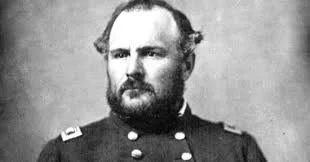
Colonel Chivington
On November 28, 1864, five months after the Hungate massacre and in the same Colorado territory, Colonel John Chivington rode with 250 men into a Cheyenne-Arapahoe camp that was primarily comprised of women, children, and old men. An American flag had been hoisted by the natives in the camp with a white flag underneath it, symbolizing peace. Peace was the reason they were there – after hundreds of years of conflict and relocations, the Cheyenne and Arapahoe had once again been asked (or some may say, volun-told) to give up their territories in Colorado, Kansas, and Nebraska to make room for Americans who were moving westward in the newly-begun Rocky Mountain gold rush. When the chiefs of these tribes agreed to cede the land, they were threatened by the soldier class (young males) of their own tribes; the same men who had been raiding American convoys and who, presumably, had murdered the Hungate family.
Chivington had been given command specifically to deal with native violence against settlers. The Cheyenne and Arapahoe had been placed between a rock and a hard place – members of their own tribes had threatened violence against them for ceding territory, and the Americans, including Governor Evans of the Colorado territory, were threatening war due to numerous accounts of violence similar to the Hungate massacre. Governor Evans had summoned the tribes to the area near Sand Creek to parlay, and they went with the full expectation of entering into negotiations. This did not happen.
As dawn broke over the camp, Chivington declined to open any sort of dialogue or negotiation with the tribal elders. Instead, without warning or provocation, he ordered his men to open fire and kill everyone in the camp. The soldiers poured cannon fire into the camp before running through it with cavalry, firing upon anyone that moved, including women and children. Some notable quotes:
I saw the bodies of those lying there cut all to pieces, worse mutilated than any I ever saw before; the women cut all to pieces ... With knives; scalped; their brains knocked out; children two or three months old; all ages lying there, from sucking infants up to warriors ... By whom were they mutilated? By the United States troops ... - John S. Smith, Congressional Testimony of Mr. John S. Smith, 1865
I saw one squaw lying on the bank, whose leg had been broken. A soldier came up to her with a drawn sabre. She raised her arm to protect herself; he struck, breaking her arm. She rolled over, and raised her other arm; he struck, breaking that, and then left her with out killing her. I saw one squaw cut open, with an unborn child lying by her side.
— Robert Bent, New York Tribune, 1879
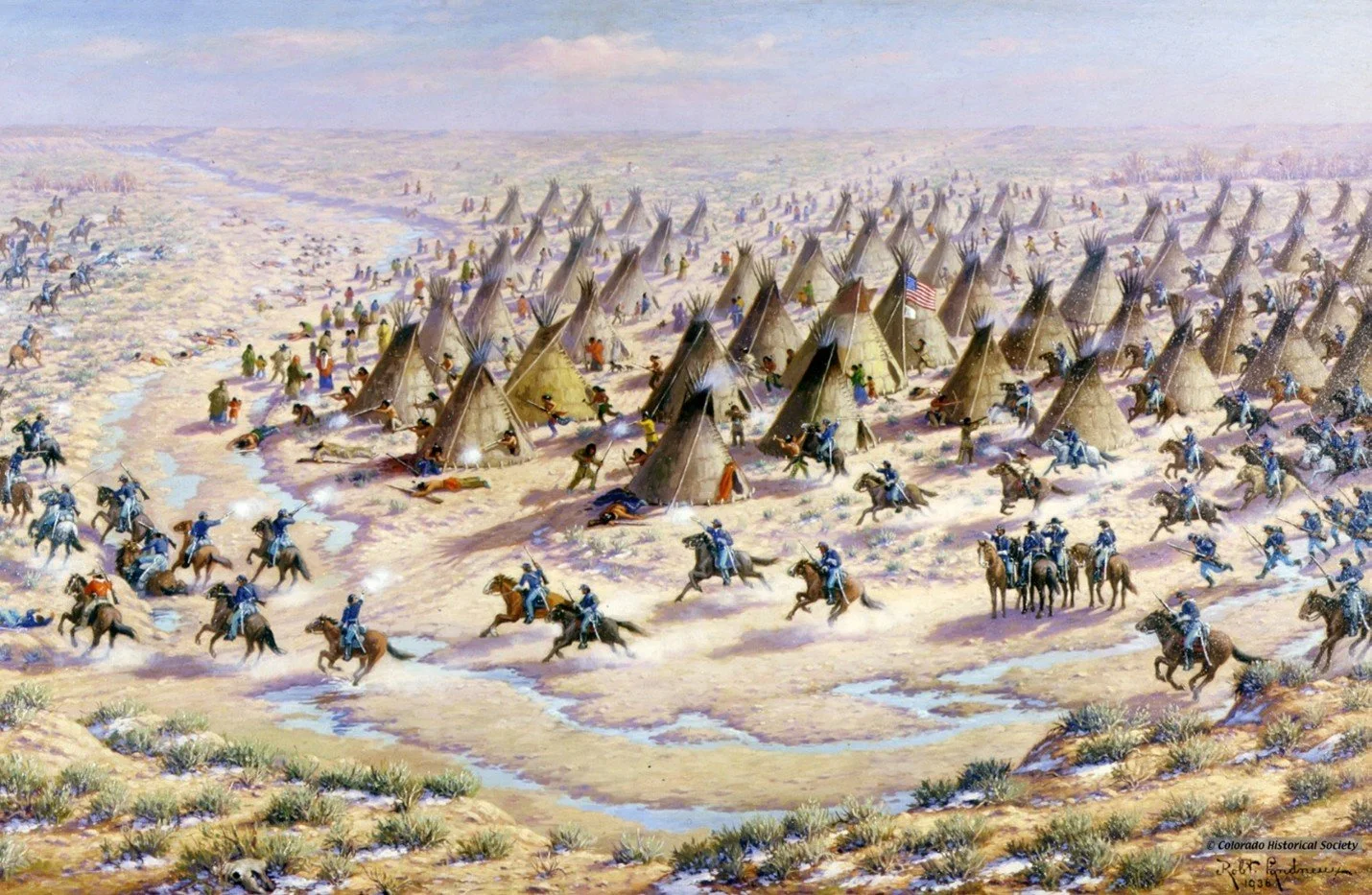
Sand Creek
The carnage inflicted on these people eerily echoed those of white settlers killed in massacres, like the Hungates. Chivington himself estimated between five and six hundred dead. Modern historians bring that number down to 150-200, but everyone agrees that the vast majority of the dead were women and children.
I sincerely apologize for opening an article with such grisly and disgusting tales, but it is important to set the tone for what atmosphere Americans and native peoples were living in at the time. Without understanding this atmosphere, we may never understand what motivated them to take the actions they did.
What is Genocide?
Much ado today is made of the word ‘genocide.’ It is thrown around for virtually anything, including speech censorship, immigration patterns, law enforcement actions, and more. Using the word so often dilutes the power that it has, and we often forget exactly what the word is intended to convey. When reading these accounts, it is hard to call these actions by any word other than genocide. Colonel Chivington himself admits to this. He is quoted:
Damn any man who sympathizes with Indians! ... I have come to kill Indians, and believe it is right and honorable to use any means under God's heaven to kill Indians. ... Kill and scalp all, big and little; nits make lice.
The last bit, nits make lice, is a metaphor. Nits are the larval stage of lice, and I will leave it to the reader to draw that connection.
When discussing these events, much modern discourse reverts back to ‘who started it.’ Perhaps Chivington was right to exterminate the natives for the heinous atrocities they committed. Perhaps the Arapahoe were right to murder the Hungates for stealing their lands and erasing their culture. Perhaps the natives should have welcomed the white colonists; diversity, after all, is a strength. Or, perhaps, the colonists should have stayed in Europe. Such discussions, however, are outside the purview of this article as they already make up numerous papers and books. Today we seek to answer only these questions: Is it possible for the natives and colonists to have coexisted? If so, what would that society have looked like? If not, what does that tell us about today’s world?
To begin, we must first address intent. The intent at Sand Creek and the Hungate ranch was clearly genocide, but what was the intent of both colonists and natives at first contact? Its hard to answer that question outright; there were many different factions with different goals at the dawn of colonization. The Iroquois were not the same as the Cherokee, nor the Pueblo, nor the Nez Pierce. Likewise, the English were not the same as the French, Spanish, or Dutch. As such, relationships between European powers and individual tribes varied dramatically. Many tribes would end up fighting on the side of colonial powers against other tribes, such as the Algonquin and Ojibwa joining with the French against the Iroquois confederacy. Some Europeans would fight alongside natives, such as the English fighting alongside the Shawnee against Americans in 1812. These relationships are difficult to track, but are also beside the point. Very clearly, it can be noted that genocide and eradication were never the original intent of either native or colonist groups. A great example of this shows up in the first-hand account of Master George Percy, who documented the first six months of the Jamestown colony in Virginia. He states:
“. . . The six and twentieth day of April, about four o’clock in the morning, we descried the Land of Virginia. The same day we entered into the Bay of Chesupioc [Chesapeake] directly, without any let or hindrance. There we landed and discovered [explored] a little way, but we could find nothing worth the speaking of, but fair meadows and goodly tall Trees, with such Fresh-waters running through the woods, as I was almost ravished at the first sight thereof. At night, when we were going aboard, there came the Savages creeping upon all fours, from the Hills, like Bears, with their Bows in their mouths, [who] charged us very desperately in the faces, hurt Captain Gabriel Archer in both his hands, and a sailor in two places of the body very dangerous. After they had spent their Arrows, and felt the sharpness of our shot, they retired into the Woods with a great noise, and so left us.”
On the very first night the colonists spent in Virginia, they had already been attacked by natives. However, not even one month later, Percy makes this second entry, which is worth quoting at length:
“The nine and twentieth day we set up a Cross at Chesupioc Bay, and named that place Cape Henry. Thirtieth day, we came with our ships to Cape Comfort; where we saw five Savages running on the shore. Presently the Captain caused the shallop to be manned; so rowing to the shore, the Captain called to them in sign of friendship, but they were at first very timerous, until they saw the Captain lay his hand on his heart; upon that they laid down their Bows and Arrows, and came very boldly to us, making signs to come ashore to their Town, which is called by the Savages Kecoughtan [“great town,” commanded by a son of Powhatan]. We coasted to their Town, rowing over a River running into the Main[land], where these Savages swam over with their Bows and Arrows in their mouths. When we came over to the other side, there was a many of other Savages which directed us to their Town, where we were entertained by them very kindly. When we came first a Land they made a doleful noise, laying their faces to the ground, scratching the earth with their nails. We did think they had been at their Idolatry. When they had ended their Ceremonies, they went into their houses and brought out mats and laid upon the ground: the chiefest of them sat all in a rank; the meanest sort brought us such dainties as they had, and of their bread which they make of their Maize or Gennea [Guinea] wheat. They would not suffer us to eat unless we sat down, which we did on a Mat right against them. After we were well satisfied they gave us of their Tobacco, which they took in a pipe made artificially of earth as ours are, but far bigger, with the bowl fashioned together with a piece of fine copper. After they had feasted us, they showed us, in welcome, their manner of dancing, which was in this fashion. One of the Savages standing in the midst singing, beating one hand against another, all the rest dancing about him, shouting, howling, and stamping against the ground, with many Antic tricks and faces, making noise like so many Wolves or Devils.”
I’ve chosen these passages because they are real events that act as a general summation of the relationship between colonists and natives across the entire continent. Many of us are taught narratives that the colonists were bloodthirsty warriors who immediately sought conversion and genocide of native peoples. The other half of the story is the opposite, that natives were bloodthirsty savages. Realistically, neither perspective is correct.
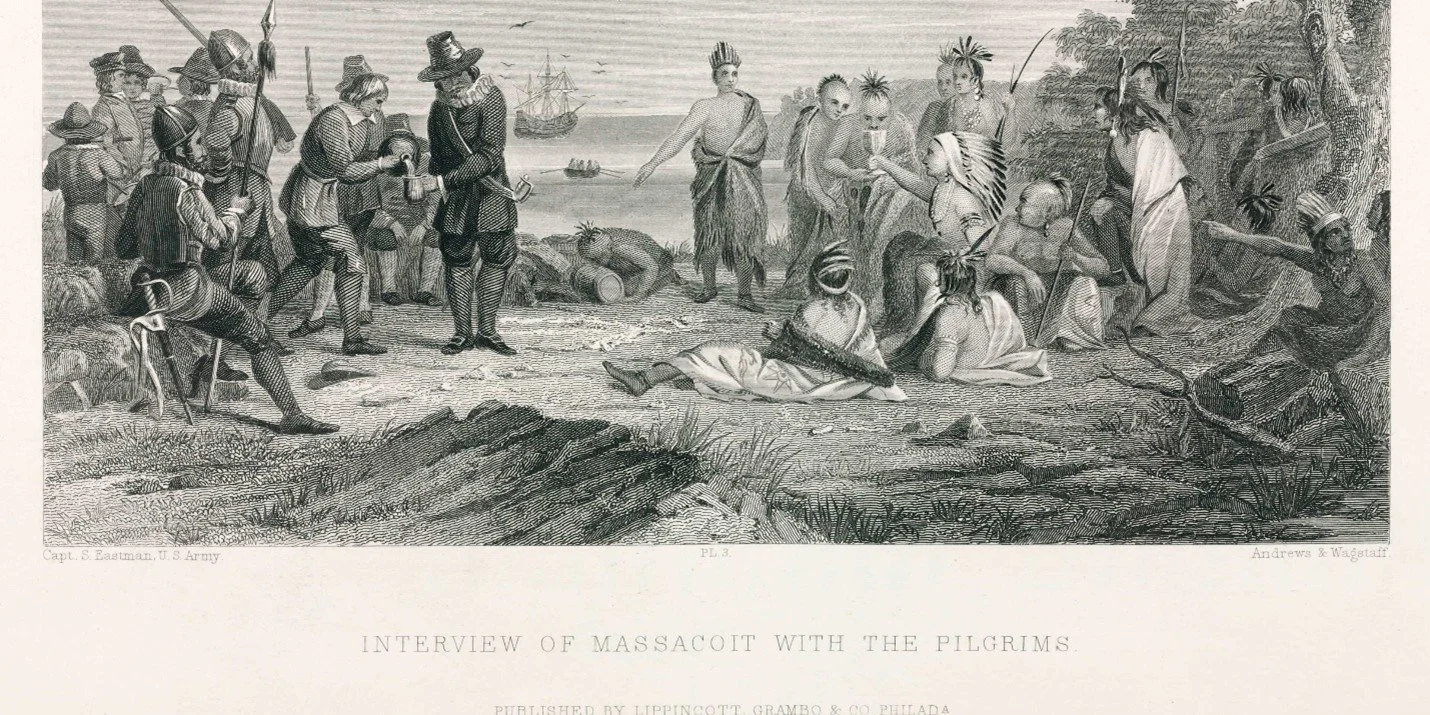
The Thanksgiving story is a great example of this myth; the pilgrims, upon landing at Plymouth right before winter, were suffering badly. Half of their party had already died from starvation and disease. Out of the goodness of their hearts, the Wampanoag people taught the pilgrims how to grow and catch food, keeping them fed through the winter. To celebrate, the pilgrims held a festival to share in their thanksgiving. Except this isn’t really what happened.
The Wampanoag people didn’t help the pilgrims for no reason. In reality, they already had knowledge of English settlers. Prior to the Thanksgiving story, the Wampanoag had engaged in skirmishes with the English and had some of their own people stolen and sold into slavery. While the initial English explorers didn’t stay, they did leave behind a crippling disease, thought to be smallpox, that wreaked havoc on the Wampanoag. In short, the first contact story for this tribe was not as friendly as we are made to believe. With their reduced numbers, the Wampanoag began to suffer greatly from rival tribes taking their territory. When the English showed up again, the Wampanoag thought it would be more strategically advantageous to ally with the English against rival tribes. The calculation at the time was that the rival tribes were more of a threat than the English. This is why they opted to help them, even though some in their tribe made the argument that the pilgrims should be wiped out.
Clearly, colonial relationships with tribal peoples were not so cut and dry. Some were allies, some were enemies, and some were allies and before becoming enemies. You will never see this nuance in modern discourse, but we must try. It is important to acknowledge that no faction in this scenario set out with the intent of genocide, but rather was solely motivated by the success of their own respective faction. Sometimes this fostered cooperation, and many times it did not.
Over time, of course, attitudes changed. The colonists thought it their utmost, God-given duty to convert natives not only to Christianity, but also towards western ways of life. A few quotes that illustrate this:
“For their civilizing, I conceive it safest to proceed by gentle degrees; first to win them to civility of life, then to godliness.” -John Elliot, missionary and preacher, 1671.
“To encourage them to abandon their wandering life and become herdsmen and cultivators of the earth, seems likely to be the best means of preparing them for civilization and ultimately for citizenship.” -George Washington, 1790
The condition of the Indian cannot be improved while he retains his habits... He must be civilized, and this can only be accomplished by placing him in contact with civilized man.” Lewis Cass, Governor of Michigan Territory, 1827.
“To civilize the Indians, attach them to the land, give them a sense of property, and restore them to society, the arts of husbandry and of domestic life must be introduced.” Henry Knox, U.S. Secretary of War, 1791.
“The great object is to reclaim these children of the forest from their wandering, savage habits, to introduce among them the blessings of civilization and Christianity.” – Jedidiah Morse, missionary and cartographer, 1822.
Clearly, conversion was a goal of the colonists. We must ask ourselves, however, if this was truly an evil goal, or if it was a noble goal that was poorly executed. Native Americans, especially in North America, were significantly behind virtually every corner of the globe in terms of technological and cultural advancement. They had no written language, no books, and poor medicine. They had poor farming practices, zero infrastructure outside religious buildings, and had not even begun use of the wheel. Bronze had been invented roughly four thousand years prior in the Middle East, and iron not long after in modern-day Turkey. When the colonists arrived in the New World with steel, they came upon natives that had not moved beyond stone for their tools. Many people today will challenge these assertions by saying that the natives simply had no use for these technologies, or that their culture did not prioritize them, but that is simply false. Native communities traded heavily and aggressively for European tools like steel hatchets, muskets, pots, kettles, and carts at their first opportunity to do so. Many tribes used European weapons against other tribes, signaling that the initial interest in these weapons was not to use them against colonists.
Upon seeing this technological and religious gap, the attitude of colonists most certainly did turn to conversion and assimilation. From a western perspective, when viewing a technologically laggard group of people with no reading or writing, no infrastructure, and a religion that, especially in South America, heavily emphasizes human sacrifice, is it not the noble thing to do to correct that behavior? Some major themes that colonists required of native peoples were monogamy, literacy, land cultivation, private property, and legal credibility. At the time, it is hard to imagine that the colonists did this out of spite or hatred.
Over time, spite and hatred certainly evolved. Americans would end up forcibly converting natives through violence, coercion, kidnapping, and dubiously legal ‘treaties.’ The Wampanoag tribe of the famous Thanksgiving story did not have a happy ending. Roughly 50 years after their treaty was signed with the pilgrims, the Wampanoag were forced into an alliance with their once rival tribes to fight against the English encroachment. The English colonists, for 50 years, allowed farm animals to wander outside of agreed upon territory and then claimed the expanded territory as their own while breaking previously agreed-upon treaties to do it. While they had advocated for the native adoption of western values, they clearly viewed the natives as their inferior. In a zero-sum game, this left the Wampanoag in a bad spot. By the end of what would become known as King Philip’s War, the Wampanoag were almost entirely wiped out.
The execution of colonial goals, regardless of intent, were almost always significantly worse than the problem they were trying to solve. In a sense, the medicine was far worse than the disease. When evaluating whether natives and colonists could occupy the same space, both literally and culturally, it appears that the answer is no, despite early attempts by both sides. Some natives were friendly, others were immediately hostile. Some colonists were friendly, and some immediately hostile. In the end, their competing goals and ideologies did not allow them to co-exist.
The Indian Removal Act of 1830
Such was the landscape that spurred the introduction of the Indian Removal Act over thirty years before the Sand Creek massacre. We have already subjected you to over 3,000 words of native and colonial history which, while still woefully insufficient to address the topic as a whole, provides enough backdrop to understand the climate in which the Indian Removal Act was implemented.
This act of Congress was specifically targeted at five tribes: The Cherokee, Choctaw, Chickasaw, Seminole, and Creek. Interestingly, these tribes collectively were referred to, at the time, as the “Five Civilized Tribes” due to their adoption of the Western values listed above. This included the Christianity, literacy, free markets, and even extensive intermarriage with Anglo populations. Most importantly was the native adoption of western-style land tenure. Specifically, the five tribes had adopted formal state boundaries that delineated their territory from the states of Georgia and Alabama, but lay wholly within the boundaries of the two states, similarly to how Lesotho lies within South Africa today.
Far from being a draconian act of genocide and vengeance against native peoples, the Indian Removal act itself was extremely controversial at the time, and Andrew Jackson acknowledges this in his 1829 State of the Union Speech. He states:
It has long been the policy of Government to introduce among them the arts of civilization, in the hope of gradually reclaiming them from a wandering life. This policy has, however, been coupled with another wholly incompatible with its success. Professing a desire to civilize and settle them, we have at the same time lost no opportunity to purchase their lands and thrust them farther into the wilderness. By this means they have not only been kept in a wandering state, but been led to look upon us as unjust and indifferent to their fate. Thus, though lavish in its expenditures upon the subject, Government has constantly defeated its own policy, and the Indians in general, receding farther and farther to the west, have retained their savage habits.
The policy of the federal government had actually been integration of native peoples; not removal. Examples include the Indian Civilization Fund Act of 1819, Jefferson’s Civilization Policies, and the Indian Trade and Intercourse Act. As such, the vote to remove natives from the southeastern United States was seen as exceptionally drastic and the final vote was very close. It passed the Senate 28-19, and the House by only four votes, 101-97.
In addition to cultural and historical antagonism between the two cultures, the final argument made in favor of relocation was a philosophic and legal dispute over how territorial integrity ought to be managed. The Supreme Court held in the 1832 case Worcester V. Georgia that states did not hold authority over native lands, much to Jackson’s chagrin. This meant that native lands must exist with autonomy inside the established states of the U.S. In other words, a potentially hostile foreign entity would exist autonomously within multiple U.S. states. This landmark case laid bare the options available to the U.S. government and the urgency with which they needed to address them. These options are truly the crux of this article, so do not miss the gravity of this analysis. Historian Francis Paul Prucha argues that at this stage in history, Jackson and the U.S. government had four options:
1. Genocide the natives.
2. Accept an autonomous native nation within the borders of existing U.S. states.
3. Disallow independent native states and force them to become U.S. citizens of the state in which they reside.
4. Force natives to move to autonomous lands in which they would not reside within the territories of the United States.
As anyone can see, these are excruciating choices, and the politicians who made them did not do so lightly.
Firstly, it cannot be casually dismissed that genocide was a viable option. As we have seen with the Sand Creek massacre, this option had been and will again be used on certain tribes of natives. However, the notion that Americans at this point were bloodthirsty warmongers must be vociferously opposed. The Whig party, as well as almost the entirety of the American clergy and missionary system, strongly opposed Indian removal. They filed numerous bills to allow natives to retain their land with autonomy. Jeremiah Evarts, better known by his pen name William Penn, said:
"...we have done so much to destroy the Indians, and so little to save them; and that, before another step is taken, there should be the most thorough deliberation, on the part of all our constituted authorities, lest we act in such a manner as to expose ourselves to the judgments of heaven".
Other notable Americans, such as Henry Clay and Davy Crockett, spoke out strongly against native removal, which ought to signal how much stronger domestic opinion would be to outright violence and genocide. So why not allow them autonomy?
The second option, autonomy within U.S. states, was also unachievable. Return to the story of the Hungate massacre and remember that it is but one of thousands of similar stories; while Anglo-native relations were not always sour, they very frequently were. Tribes that were once friendly could turn into foes very quickly, like the Wampanoag. Likewise, it was functionally impossible for the U.S. federal government at the time to prevent colonists from illegally annexing land. In 1763, King George III issued a proclamation line that stated no colonists could settle lands west of the Appalachian Mountains. This edict was not followed or enforced in the slightest, and Anglo encroachment on the lands of natives in the south was frequent. The U.S. population was small but growing rapidly and, without modern surveying or surveillance technology, boundaries were flagrantly violated. The position is well-founded that native-Anglo conflict was largely driven by encroachment on native land and continual breaches of treaties with native peoples. Whether the encroachment of Anglo people onto native land was right or wrong, to Jackson, was not black or white. While he did recognize that native peoples were losing their land illegally, he also believed that Anglo colonization was a net positive force, even for native peoples. This is a position many told hold as well, but we will visit that in a moment. Regardless of morality, increased settlement of native lands was guaranteed to continue and would inherently increase the chance of conflict between settlers and tribal peoples.
This was not a theory but a reality of colonial life at the time. By 1830, The fledgling U.S. was or had been embroiled in Pontiac’s war (1763), The Anglo-Cherokee War (1758), the Second Anglo-Cherokee War (1775), the Northwestern Indian War (1785), War of 1812, The Creek War (1813), Anglo-Powhatan Wars (1610), Pequot War (1638), Tuscarora War (1711), Yamasee War (1715), and so many others. These are but a handful of all wars between native and Anglo populations. Imagine being an American at the time and having two hundred years of brutal, despicable, and horrific war crimes against yourself or your neighbors, only to be asked to then house an autonomous native country within your state. It was simply unallowable to the American conscience to share citizenry with people who had committed so many atrocities during centuries of war. This mentality, coupled with constant illegal colonial encroachment on these lands, ensured that war was inevitable.
The third option, to make natives citizens of the state they resided within, was actually Jackson’s preferred option. He states:
“A portion, however, of the Southern tribes, having mingled much with the whites and made some progress in the arts of civilized life, have lately attempted to erect an independent government within the limits of Georgia and Alabama. These States, claiming to be the only sovereigns within their territories, extended their laws over the Indians, which induced the latter to call upon the United States for protection....
I informed the Indians inhabiting parts of Georgia and Alabama that their attempt to establish an independent government would not be countenanced by the Executive of the United States, and advised them to emigrate beyond the Mississippi or submit to the laws of those States....”
This left option number four: removal. The Indian Removal Act did not force natives to leave their land. What it did was open two options for tribes: accept payments and land out west, or remain and become a citizen of the United States. For some tribes, like the Choctaw and Cherokee, treaties were signed that formally ceded their lands to the United States in exchange for their autonomy in modern-day Oklahoma. Some tribes, like the Creek, took a halfway measure, where some individuals signed a treaty and left, while others remained and became citizens. Others, like the Seminole, chose neither option. Instead, they kept their land and opted for war, leading to the Second Seminole war in which over 1,500 Americans and 3,000 Seminole were killed. In 1832, the Treaty of Moultrie creek reduced Seminole land from 34 million acres to 4 million.
Given these choices, one would be forgiven for thinking that Indian removal was, in fact, the moderate and sensible option. Jackson certainly thought so.
“Our ancestors found them the uncontrolled possessors of these vast regions. By persuasion and force they have been made to retire from river to river and from mountain to mountain, until some of the tribes have become extinct and others have left but remnants to preserve for a while their once terrible name. Surrounded by the whites with their arts of civilization, which by destroying the resources of the savage doom him to weakness and decay, the fate of the Mohegan, the Narragansett, and the Delaware is fast overtaking the Choctaw, the Cherokee, and the Creek. That this fate surely awaits them if they remain within the limits of the States does not admit of a doubt. Humanity and national honor demand that every effort should be made to avert so great a calamity...”
This is not just Jackson’s opinion. Historian Robert Remini, in his book Andrew Jackson and His Indian Wars, states:
“Jackson genuinely believed that what he had accomplished rescued these people from inevitable annihilation. And although that statement sounds monstrous, and although no one in the modern world wishes to accept or believe it, that is exactly what he did. He saved the Five Civilized Nations from probable extinction.”
In light of the other options, including genocide, we may begin to see Indian Removal in a new light.
Modern Implications
The purpose of policy is to implement actions that will benefit current and future generations. The problem with reviewing the efficacy of policy is that, while you can measure what a policy does, you cannot measure what a policy didn’t do. To evaluate whether Jackson’s decision ultimately was the best decision, we must muse about the outcomes of what could have happened should he have chosen another option.
To begin, it is difficult to imagine the implications of mass genocide. Contrary to popular belief, the United States has never committed genocide; not against the natives, not against enslaved Africans, not against Mexicans, nor any of its domestic adversaries. Therefore, it is likely impossible to deduce what genocide would entail. Perhaps it would have created a war between natives and their sympathizers that would have destroyed the U.S. Perhaps it would have ushered in a perpetual Anglo-American identity that would have brought peace and stability forevermore. Because this was never a serious policy (and never will be), it is foolish to consider the implications. Instead, we will focus on integration and how it would affect the nation today.
Race relations in 2026 are, too be blunt, very poor. The relationship between whites and every single minority group has fallen dramatically. In reality, the United States has not been able to implement E Pluribus Unum (of many, one). Instead, we are roughly two, if not three of four, separate nations wearing a trench coat disguised as one. A 2021 study shows this to us in stark terms:
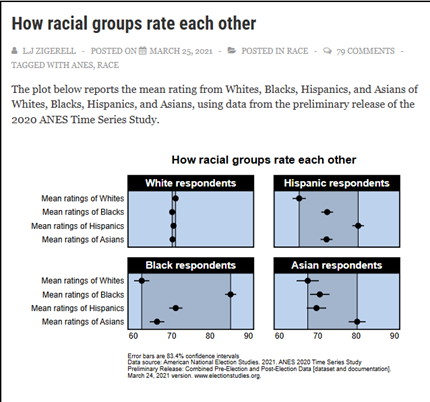
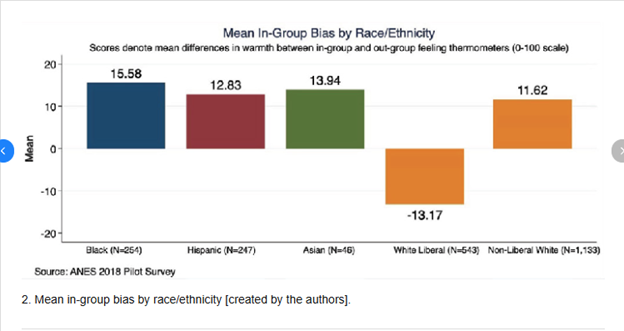
Shockingly, it is white respondents that are the only group that rate all races the same. When diving further into the data, it is only white liberals that do not have an in-group bias. Most interesting is that all other races rate whites the lowest. One will note that Native Americans are not included in this chart. If they were, it is no doubt the results would be the same, and perhaps rightfully so. No one would blame them for hating whites. However, to Andrew Jackson’s point, this would only sow even more chaos and discord were the two societies allowed to share the same physical and cultural-political space.
This information is shocking. How can it be that every single race on earth discriminates against others, especially against whites, except for white people? This topic will likely become another article for us down the line. For now, please understand that, as a significant voting block, or more importantly, as an autonomous nation with a significant population in the U.S., Native American sentiments against whites would create a significant stumbling block to national unity, cultural cohesiveness, and general happiness for the majority-white population. The reason this matters is because it has real-world effects. Antagonism doesn’t simply live on Twitter; it shapes everything from the judicial system, to Congress, to neighborhood dynamics, real estate prices, federal spending, and more.
In 1995, the trial of O.J. Simpson somehow procured 9 black jurors, which constituted 75% of the jury. As everyone knows, Simpson would be found not guilty. One juror, a black woman named Carrie Bess, was interviewed about the case many decades later. In the interview, she candidly stated that 90% of the jurors, including herself, actually believed that Simpson was guilty. However, they voted not guilty as a form of retribution against white people. Specifically, they voted in retaliation to officers who were acquitted in the slaying of Rodney King three years earlier. This is not a one-off case.
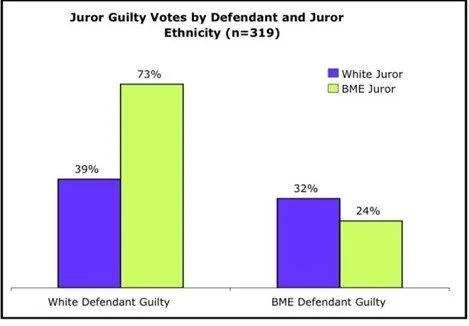
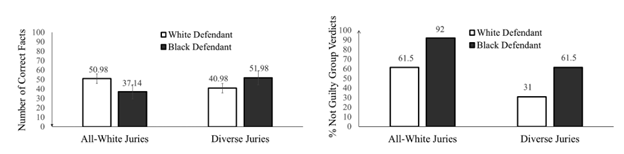
As one can see, black jurors are overwhelmingly more likely to convict a white defendant and acquit black defendants by a wide margin. White jurors do not follow the same pattern. This holds with the graph above that shows mean in-group biases; whites do not show favoritism towards whites, while every other race shows favoritism to themselves. This is, quite literally, the definition of an unjust system.
Another case study is employment. As the culture war rages on in America, millions of businesses openly discriminate against white people. The only race to see negative employment changes since 2020 are white people, and it is by a significant margin.

Competition for resources is typically a zero-sum game. When one person wins, another loses. If competition for jobs is based on merit, qualified people win. If competition is based on race, one person wins and everyone else loses. By adding more races into the competition, by definition, one creates increasingly more losers and, by extension, increases social conflict dramatically.
Of course, it is not just to say that, to avoid competition, it is moral to eliminate it. Rather, our point in examining this is to show that Jackson’s concern about the intermixing of disparate ethnicities within one society was based in reality. Behold the below compilation of just a handful of headlines produced in the last few years.

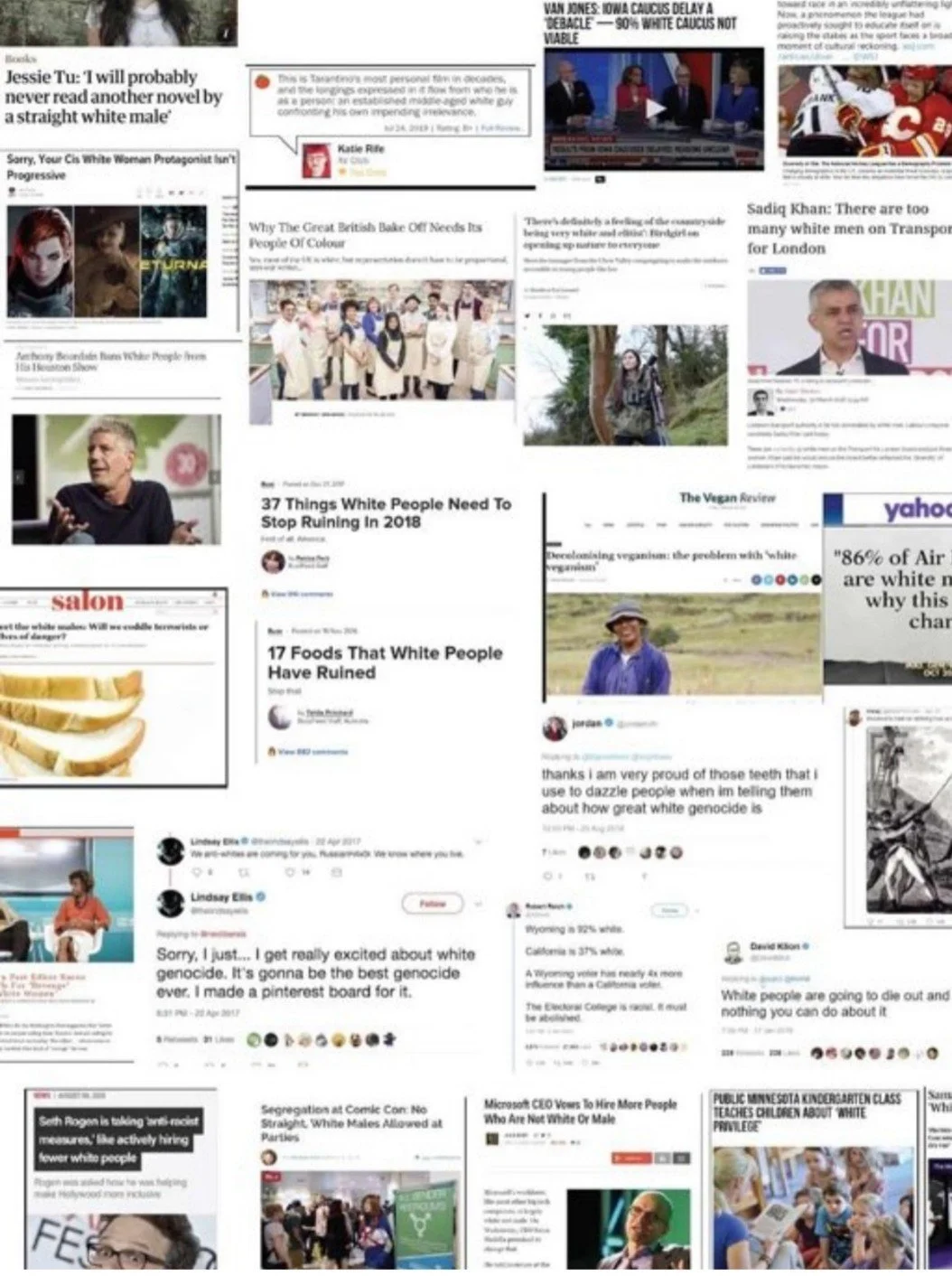
Is this the narrative of a healthy, functioning society? Or is it the narrative of thousands of sharks circling their prey, waiting to take it down at the right moment? Such is the exact same sentiment Jackson encountered in 1830. Jackson knew that it was unlikely for natives and Anglo populations to simply put hundreds of years of genocide aside in favor of assimilation. Put plainly, it is unrealistic to expect any demographic to endure competition when it is a choice to do so, and not a requirement of nature. This is as true today as it was then. When you add more and more demographic groups to the system, the more competitive the system becomes. In a world where one demographic must quantifiably fend for itself against all the rest, it makes no sense to allow hostile ideologies any room to compete. In Jackson’s evaluation, this type of racial, zero-sum conflict would carry with it endless wars and, ultimately, the complete and total destruction of one party or the other. In his estimation, it would be the destruction of native tribes. He viewed, as we also do, the physical separation of competing ideologies to be paramount in establishing real peace and prosperity.
I encourage you to consider the following: if native tribes and Anglo Americans were still competing at an equal level today, what effect would that have on institutions like Congress, where racial makeups already provide constant anguish and consternation? How would states navigate districting and gerrymandering nightmares based on racial ties split more ways than they already are? Likewise, how would we navigate Medicare, Medicaid, public lands, and other forms of federal spending which are already fought over tooth and nail? It is unlikely that these systems would fair better under more rabid competition. Increasing competition for jobs, federal spending, congressional representation, and other, non-quantifiable items like food, music, and cultural influence would surely shatter our country. Jackson’s decision to prevent this required an iron will, but was ultimately necessary. To this, many opponents will simply say that the only true solution was for colonists to never have invaded in the first place. Perhaps this is so, but it misses the unaddressed elephant in the room.
At the 2026 Grammy Award Ceremony, singer Billie Eilish used her moment of fame to preach the oft-recited phrase “there is no such thing as an illegal on stolen land.” Ironically, Eilish’s home sits on land that once belonged to the Tongva tribe. Is response to her comments, a Tongva tribal spokesperson said:
“We do value moments when public figures bring attention to the real history of this country,” the spokesperson said. “However, it is our hope that in future discussions, the tribe can be explicitly referenced so the public understands that the greater Los Angeles Basin remains Gabrieleno Tongva territory.”
That’s right; hundreds of years later, the Tongva still claim that the Los Angeles area is rightfully theirs. Perhaps this is true – perhaps it isn’t, but Eilish certainly believes that it is stolen land. Curiously, she has made no overtures to return the land or her house to the Tongva. This humorous episode reveals a more serious reality; even though Americans both then and now recognized a great injustice was done to the native peoples, they also recognize that America is now home to a new people who have created a nation with a very high standard of living. Unsurprisingly, nobody is willing to give that up. Jackson himself realized this brutal dichotomy and we will leave you to ponder this final quote, which resonates as much today as it did then:
“Humanity has often wept over the fate of the aborigines of this country, and philanthropy has been long busily employed in devising means to avert it, but its progress has never for a moment been arrested, and one by one have many powerful tribes disappeared from the earth. To follow to the tomb the last of his race and to tread on the graves of extinct nations excites melancholy reflections. But true philanthropy reconciles the mind to these vicissitudes as it does to the extinction of one generation to make room for another....Nor is there anything in this which, upon a comprehensive view of the general interests of the human race, is to be regretted. Philanthropy could not wish to see this continent restored to the condition in which it was found by our forebears. What good man would prefer a country covered with forests and ranged by a few thousand savages to our extensive Republic, studded with cities, towns, and prosperous farms?”
Surely Eilish would agree.
It is our genuine and sincere hope that one day, all inhabitants of this great country can find shared values and common ground. That we can all inhabit the same literal and metaphorical space without conflict or infighting. We ought to be clear that genocide and violence is always worse than the problems it intends to solve, and thus can never be a true remedy. However, in the event that common fidelity and shared cultures cannot be found, it is more prudent to live separately than it is to force an uneasy and impermanent peace.