
The Collapse of American Education
Before reading this article, have an attempt at these questions:
Translate this phrase into Latin: Who is more illustrious in Greece than Themistocles? Who, when he had been driven into exile did not do harm to this thankless country, but did the same that Corialanus had done twenty years before?
Translate into Greek: But when the messenger had added this also, that he had died victorious, Xenophon put the garland on again.
Draw a line around the basin of the Po, Mississippi, and St. Lawrence rivers.
What is the source of the Danube, Amazon, Volga, and Ganges?
Divide 33368949.63 by 0.007253.
Find the cube root of 0.0093 and the square root 531.5 to three decimal places.
If you can’t answer a single one, you’re not alone. This is just a small fraction of the original entrance exam required at Harvard University in 1869. In 1870, Harvard only had a paltry 210 applicants due to the stringent entrance requirements. The full exam is worth reading and highlights two important motifs: the first is the expectation of an ivy-league educated, Renaissance man in the 19th century. The second is to provide a framework by which we can compare older levels of rigor to today’s academic standards.
I believe we could count on one hand the number of people in the country today that would be able to pass this exam. Perhaps this is rightfully so; translating Latin and Greek are skills not as much in demand as, say, engineering mathematics. However, this argument belies another conundrum the education industry must address: What is the purpose of education? If the purpose is to create a well-rounded citizen, capable of engaging in all aspects of civilized society, then creating a true Renaissance man would be of the utmost importance, regardless of employment opportunities. This is the theory that drives primary education from ages 5-18. Of course, this is not the argument being made at the university level. Here, the purpose of secondary education is to achieve gainful employment. The better the education, the better the job, or so they say. As we shall soon see, both primary and secondary education fail in each of these endeavors.
Primary Education
A nineteen year old student, Aleysha Ortiz, is suing Hartford County Public Schools because she graduated, with honors, despite not being able to read. The school system passed her on, year by year, without mandating the most basic of all education requirements. While one can attribute her failure to her own lack of effort, her case is not isolated. At 24 Illinois public schools, not a single student can read at grade level. 23 Baltimore schools have zero students proficient in math. Nationwide, 54 percent of the American adult population reads at or below a sixth-grade level.
An interesting case-study is the SEED School in Washington D.C. They enroll mostly disadvantaged students, with only 23 percent of applicants living in a two-parent household and 62 percent living with their mother. 75 percent of students qualify for free lunch. This is a public school (taxpayer funded) that boasts yearly per-pupil spending of $63,000, almost equivalent to four years of education at an in-state university. Attendance at SEED is drawn based on lottery, so the factors affecting student performance can reliably be compared to other schools in the region. What does $63k a year in pupil spending get you? Turns out, nothing.
The percentage of students at SEED meeting expectations in 2024 (at least a 4 out of 5 on the PARCC exam) in English Language Teaching (reading and writing) was between 2% and 12%. The amount proficient in math was between 4% and 7%. In all, students performed roughly within the 30th percentile. Only one student passed an AP exam, and did so with the lowest score possible.
By any metric, this is not worth $63k per pupil per year. Interestingly, spending rates appear to be irrelevant as they seem to have zero effect on student outcomes. In 1998, Kansas City Public Schools spent almost $2 billion dollars after a federal judge ruled that the district was “unconstitutionally segregated, with dilapidated facilities and students who performed poorly.” To pay for this, property taxes were raised by 150%, income tax raised by 1.5%, and state coffers were emptied from other programs. Teacher pay was increased by 40% and all classrooms were renovated.
Nothing changed. Test scores stayed the same, the gap between white and black students persisted, and drop-outs increased rather than decreased. Again, this is not an isolated case. Per-pupil spending has increased significantly since 1970 while student performance has remained flat. The Department of Education has spent over $3 trillion since 1979 with nothing to show for it.
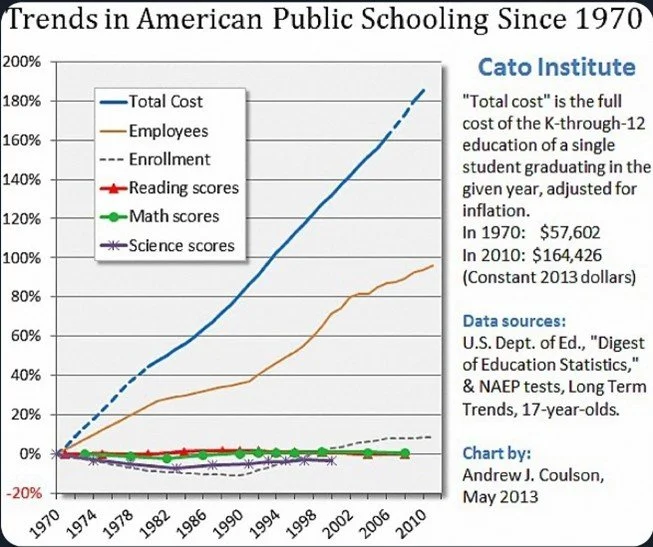
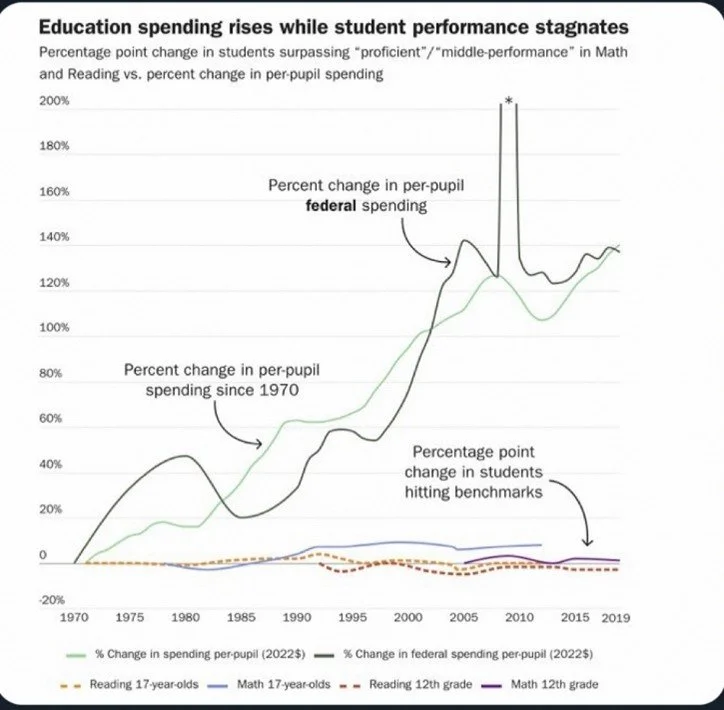
How can this be? If schools are equipped to teach children, and are given more resources to do it, how can outcomes not increase? We will decline to discuss cultural values, home life, and demographic expectations. That will be the subject of another article and cannot be controlled by the education system, much to their chagrin. Within the education industrial complex, it is a reality that schools have no interest in teaching children and are beholden to no metrics or punishments for failing to do so. At Ballou High School in D.C., only 3% of students are math proficient and only 5% are reading proficient, yet 70% graduate. If 70% of the students can graduate without being proficient in basic studies, something other than education is the goal.
Los Angeles Public Schools have lost 26% of their students since 2014, but have increased staffing by 19%.
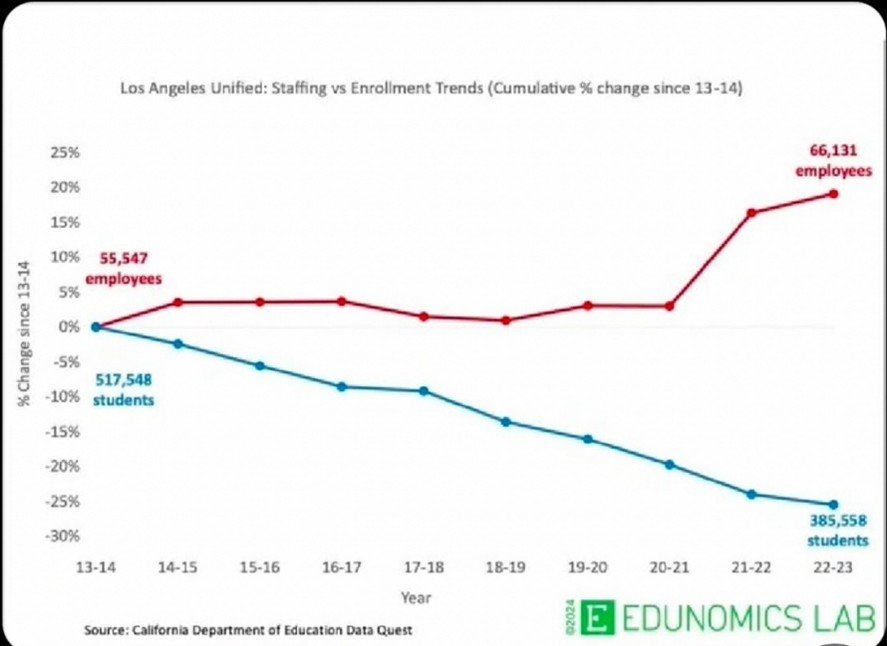
These staff have nothing to do with education but represent what is often called administrative bloat in education. Administrative bloat is the term used for the increase in middle-manager staff who do not have a teaching or researching position within the school. This passage from Lance Dinino at Boudoin College (ironically) is worth quoting at length:
Ginsberg describes the case of a Purdue administrator: a “$172,000 per year associate vice provost had been hired to oversee the work of committees charged with considering a change in the academic calendar” who defended their role to a Bloomberg reporter by stating “‘[my] job is to make sure these seven or eight committees are aware of what’s going on in the other committees.’” Consider a recent state audit of the University of California system that revealed the Office of the President had “amassed substantial reserve funds, used misleading budgeting practices, provided its employees with generous salaries and atypical benefits, and failed to satisfactorily justify its spending on system wide initiatives.” Between fiscal years 2012-13 and 2015-16, the Office of the President’s administrative spending increased by 28%, or $80 million. And 10 executives in the office whose salaries were analyzed by the audit made a total of $3.7 million in fiscal year 2014–$700,000 more than the combined salaries of their highest-paid state employee counterparts.
These people are in charge of designing new curriculum, changing the way the school operates, and other nonsensical things. For example, the San Francisco Board of Education has unveiled a new program called Grading For Equity. This program eliminates homework and weekly tests from being counted in a student’s final grade. The final score solely depends on the final exam, which can be taken multiple times. Late assignments are not penalized, and the grading rubric has become more lenient. An 80% now qualifies as an A and a score as low as 21% can still qualify as a D. Fans of basic math might realize that a 21% passing score on a four-part multiple-choice exam is statistically less likely to happen than if a student simply guesses on every answer. Middle-managers were paid hundreds of thousands of taxpayer dollars to come up with this system.
The intent of this new grading system is to prevent discrimination, but entirely ignores that this is the point of grading. Grading is inherently discriminatory. It is how you separate competent students from incompetent students. Without being able to do this, grading is without a shred of merit at all. The increase in administrative bloat directly produces these nonsensical paradigms which do nothing for student outcomes or education as a whole. Instead, they turn school into a participation trophy, similar to the experience of the student who graduated with honors despite not being able to read. She may have had good grades, but she can’t read, therefore the grade means nothing. As a result, students' reading levels have dropped to their lowest point in two decades and math has dropped to its lowest in thirty years.
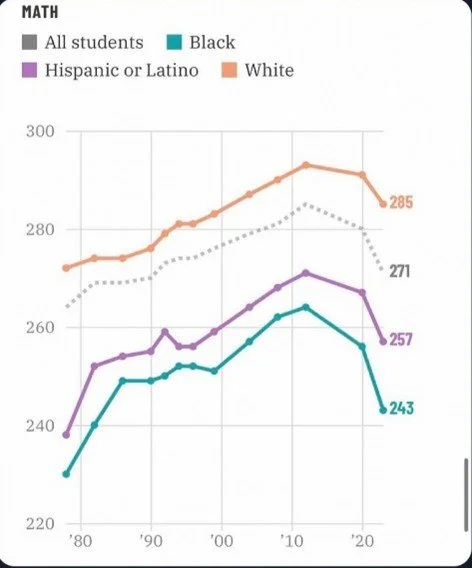
This effect is not anecdotal and can be measured. In Los Angeles, 73% of 11th graders earned above a C in math, but only 19% actually met grade-level standards. For 8th graders, 79% percent earned above a C in math, but test scores showed only 23% met grade-level standards. In English, 85% of 6th graders earned above a C, but only 40% tested at grade level.
What do the administrators think of this blatant failure? Well, they cry racism, of course. Instead of pairing low-performing students with other low-performing students, administrators have opted to eliminate classes for high-performing students and have bundled them with the general population. Seattle Public Schools shut down its gifted and talented program for being too saturated with White and Asian students. California has done the same thing, as has New York. Yes, instead of realizing that they can’t throw money at the problem nor change the standards to make themselves look good, they have instead opted to eliminate programs for high-achieving students. The United States is quite literally starving itself of high achievers across all industries and disciplines in the name of combatting racism.
Some may argue that this is correlation and not causation, but we know this is not the case. In a criminally under-reported story, Mississippi has climbed from 49th place to 9th nationally in elementary reading scores. In fact, black students are as likely to be basic-or-above readers in Mississippi as they are in Massachusetts where the average income is twice as high. So what did Mississippi do differently? First, they invested in quality education by hiring literary coaches who actually teach children instead of administrators who come up with new programs for how children should be taught. Secondly, and most importantly, Mississippi actually held back students who were not proficient. Instead of catering to the demands of race-baiting administrators and passing kids who lack basic education, Mississippi actually holds children back until they are proficient enough to move forward. As it happens, discipline is extremely effective in teaching children rather than assigning them an arbitrary ‘grade’ that has no meaning to spare their feelings. In California, only 28% of Black students can read at a basic level or above. In Mississippi, its 52%, and they spend far less money per pupil. This has been dubbed the “Mississippi Miracle” and has been adopted by numerous underperforming states, such as Tennessee, Louisiana, North Carolina, Georgia, Kentucky, and Virginia.
In 2022, 68% of campaign contributions from K-12 teachers went to Democrats, and the number is likely far higher for administrators. The administrative bloat seen in these school districts has little to do with actual education and everything to do with narrative control, just as Saul Alinsky alludes to in his book How to be a Radical. It should not be a surprise that teachers teach what they believe to be true, which is why rampant claims of racism have dominated education, as well as systemic changes that seek to upend the entire institution. The teachers see nothing but racism and Marxism, thus are impelled to teach it. In 1998, a group of teachers sued New York City claiming that the Liberal Arts and Sciences Test, a test required for a teaching license, was racist, because over 90% of white test takers passed, compared to 62% of black and 55% of Latino test takers. The lawsuit didn’t claim what inside the test was racist, only that the disparate outcomes must mean that something within the test was so. In 2012, after almost two decades of arguing, New York City paid out $1.8 billion in restitution. Primary education is nothing more than a state-controlled jobs program for anti-American leftists to exert their influence among children.
Higher Education
While shocking for primary education, this behavior is the norm for higher education. In the beginning of this article, I asked a few questions from an 1869 Harvard entrance exam. By those standards, today’s entrance exam requirements are quite weak. The SAT and ACT are by far the most common entrance examinations required by most universities. Or at least, they used to be. For the fall 2025 semester, it is estimated that over 80% of four year colleges (over 2,000 schools) are either test-optional or test-blind, meaning they won’t accept or don’t require ACT or SAT test scores upon application. For schools that still use these exams, the expectations of student performance have plummeted. Both exams have removed the need for reading long passages and writing short essays. College Board, which administers the SAT, cut reading passages from 500-750 words down to 25-150, the length of a social media post. The test also eliminated material related to the U.S. founding documents because of their “extended length.”
The reason this matters is because standardized testing is the only real way to measure applicant performance. As we saw before, primary schools hand out grades that in no way match student proficiency and performance. Students are all over the map when it comes time to apply for college, and there is no other process by which we can adjudicate readiness or competency without formalized testing. The purpose of college is to educate people who will complete endeavors that require advanced knowledge, like electrical engineering, chip manufacturing, and international logistics, all sectors our country desperately needs. When an unqualified person is accepted into schooling they can’t complete, it takes the space away from someone who is qualified, and the incompetent student usually fails out (after accruing much debt). According to the Bureau of Economic Research, standardized test scores predict academic outcomes with a normalized slope four times greater than that from high school GPA, thus removing this requirement is a significant problem.
Don’t just take my word for it. UCLA’s medical school was sued for discrimination in 2025. Shockingly, UCLA let in so many unqualified candidates under their DEI program that 50% of their student cohorts failed basic competency tests. The average national failure rate is 5%. Remember, this is for a medical school where lives are quite literally on the line. UCLA’s ranking plummeted and they are now reversing course, a trend we see across the nation.
Take Dartmouth University, who is resuming testing requirements in 2027. They say “Several key findings guided our decision [to reinstate testing requirements]: first, standardized test scores are an important predictor of a student’s success in Dartmouth’s curriculum, and this is true regardless of a student’s background or family income…Standardizes test scores can be an important predictor of academic success at a place like Dartmouth and beyond – more so than even grades or recommendations, for example.”
Yale, Brown, Harvard, Cornell, Penn, Princeton, and more are all resuming testing requirements in 2027 for this exact reason and have all released public statements very similar to Dartmouth’s. Yale’s is most interesting. “Yale’s research from before and after the pandemic has consistently demonstrated that among all application components, test scores are the single greatest predictor of a student’s future Yale grades. This is true even after controlling for family income and other demographic variables.”
It cannot be stressed enough that stringent grading systems matter. In 1985, 33% of all grades at Harvard were in the A range. By 2021, that number had risen to 79%. Given the aforementioned information, do you believe it’s more likely that students miraculously became smarter, or that the standards for what qualifies as an A were lowered? Obviously, standards for higher education have been dramatically lowered. Now, universities are being forced to fix what has been called “grade-flation” by implementing stricter grading standards. The worst part of grade-flation is that it isn’t primarily driven by increasingly difficult academic pursuits. Only roughly 30% of university students are enrolled in the hard sciences, meaning 70% of students are enrolled in courses that are not comparatively rigorous. The fact that 70% of students required a dramatic lowering of grading standards in non-rigorous coursework to reach A and B grades is worrying. We must be intellectual honest in acknowledging that some coursework is easier than others. At Yale, 92% of grades in women’s studies classes are in the A range, while only 55% percent of mathematics are in the A range. In fact, none of the hard sciences at Yale have above a 74% A range, while zero of the social studies programs have below an 80% cohort in the A range. These majors are not difficult - they are simply a participation trophy that one cannot fail.
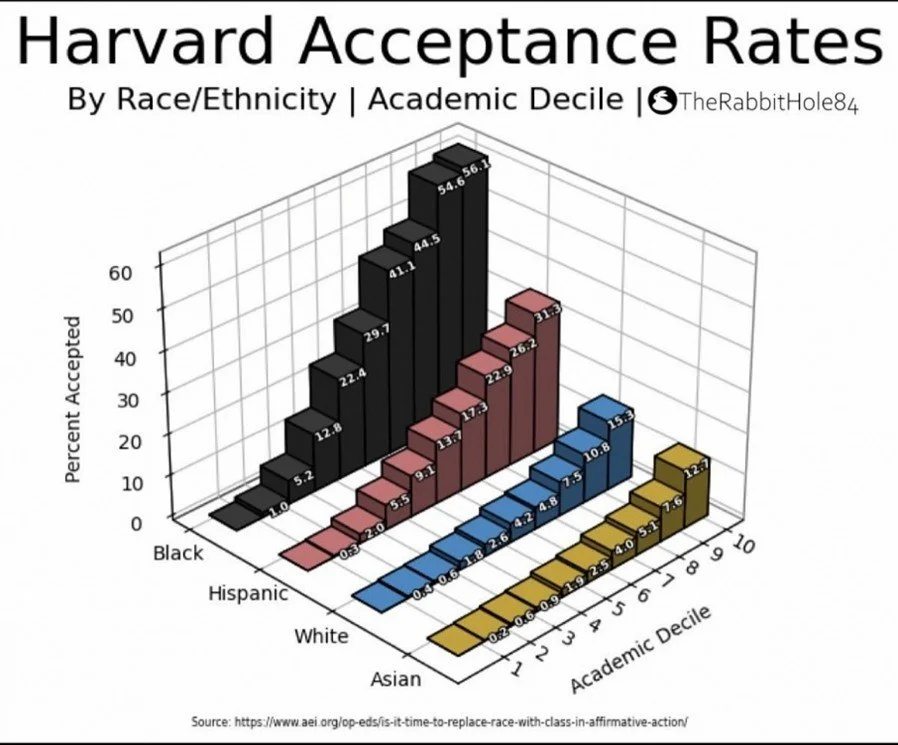
At New York University, the average SAT score for Asian students is 1485.86, 1428.23 for whites, 1355.1 for Hispanics, and 1289.87 for blacks. If each student was equally qualified, these scores should be relatively similar, but academic competency is not upon which NYU, or any other school, bases their admissions. Harvard only accepts 12.7% of Asian students in in 10th academic decile (lowest achieving students), but a whopping 31.3% of Hispanic students and 56.1% of Black students in the exact same decile. Clearly, academic integrity is not the goal. Instead, universities have become adult daycares, funded by guaranteed federal loans, that sell non-marketable skills for $100,000 of non-dischargeable debt.
Since education is not the goal of primary or secondary education, we must conclude that social engineering and financial racketeering is the true goal. At Harvard’s Graduate school of Education, they use the following “pyramid of white supremacy” to teach post-graduate students how to resists “Racial Capitalism.”
Harvard also held racially segregated graduation ceremonies for all races except whites. Curious. In fact, the National Education Association handbook, under Section I-55, says “educators must acknowledge the existence of white supremacy culture as a primary root cause of institutional racism, structural racism, and white privilege. Educators must also work to prohibit institutionally racist systems”
I believe this truly gets at the core of what is causing this hysteria; education is no longer about education, but about dismantling institutional systems of power, which universities have traditionally been.

Importantly, we can’t forget to acknowledge the university systems’ financial stake in all of this. Without exaggeration, it ought to be understood that, at best, colleges are scamming students and, at worst, are committing a Ponzi racketeering scheme that has far surpassed the Bernie Madoff and Enron scandals combined. The United States Government guarantees federal financing for virtually any college program that one is accepted to, and, as we have seen, virtually anyone can be accepted to any program. This means big bucks for universities. Since these loans are guaranteed, and the loans cannot be discharged, schools are absolutely raking in profits with zero regard to outcome. Tuition for private U.S. colleges has risen by 144% over the last 20 years, and in-state public school tuition has risen by 212%. In fact, over the last thirty years, the cost of college has increased at five times the rate of inflation. And why not? Schools can charge whatever they want and the federal government will give a loan for it, and the loan can’t be discharged. Al Capone is weeping in his grave for not thinking of a scheme this clever.
Luckily, these loans go to extremely important sectors of education, like the anti-white pyramid above, or studying Harry Potter at Baylor University. You can study Horror literature at Dartmouth, which is most assuredly worth $100,000 in tuition per year, and desperately needed in society. You can study True Crime podcasts at UT Austin, paintball at Texas A&M, DJ’ing at Berklee, ice cream at Pennsylvania state, and zombies at George Mason.
Earlier in this article, I stated that the primary purpose of secondary education is higher employment. If this is the metric, then going to university for anything other than a hard science is worthless. More than four in ten borrowers (42%) report making tradeoffs between loan payments and covering their basic needs, and one fifth (20%) of those surveyed said they are currently in either delinquency or default. If 20% seems low, keep in mind that the default risk tolerance for the average bank is .01%. Anything higher and the bank must increase interest rates or go out of business. The default rate of loans to students at major universities is 200,000% (2,000 times) higher than the standard risk acceptable to banks.
Universities will do anything to guzzle federal funding. In 2025, President Trump froze $2.2 billion in medical research to Harvard because of the aforementioned discrimination. This $2.2 billion is a drop in the bucket compared to Harvard’s $57 billion endowment fund. Harvard could have followed easy steps to get their funding back but elected not to. Instead, they maintained their discrimination policies and have decried the loss of funding without tapping into their enormous endowment. To Harvard and many schools like them, they must have taxpayer funded programs and legal discrimination all without pulling a cent from their endowment.
Why does this matter?
Our nation is in critical need of advanced degrees. We need structural, electrical, and chemical engineers; we need rocket scientists, chip manufacturers, and advanced robotics and assembly machines. We need competent doctors, lawyers, and creators. The U.S. is estimated to need 400,00 engineers per year, and is routinely 33% short. Likewise, the U.S. has fallen almost 8% in global patent applications. When the U.S. cant fill these roles or create our own products, they either sit unfilled, reducing our industrial capacity, or they are filled with migrant labor, which increases cultural discord and introduces an entirely new set of problems.

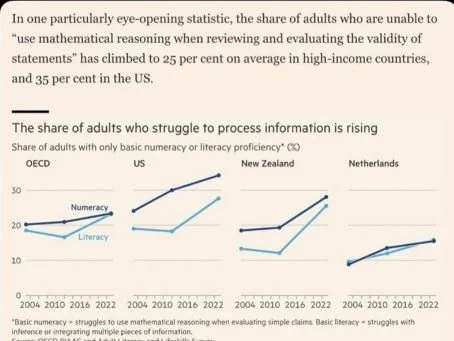
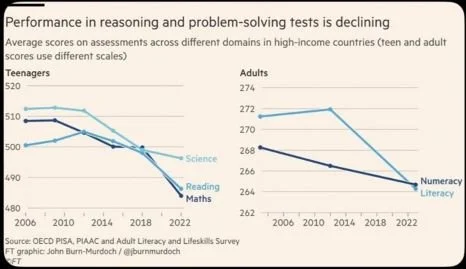
At a more broad level, our ability to process information and use reasoning to solve novel problems has been steadily falling since 2010. Likewise, the ability for adults to solve numeracy and literacy tests has also declined. Quite literally, we are becoming dumber.
This has real effects in the real world: a 2020 medical research paper claimed that black babies born under black doctors experience a 58% drop in mortality rates. This narrative created cultural shockwaves around the country and facilitated a mass upheaval in the way medical schools and medical facilities across the country operate. The problem was, not only was this study absolute nonsense, but they actually censored other findings. The results of the study were completely nullified when controlling for birth weight of infants and there was, in fact, no racial discrimination in black vs white doctors attending to black babies. They did discover, however, that white newborns face 80 more deaths per 100,000 births with a black doctor than a white one. I surmise this is due to incompetency of black doctors allowed to graduate schools like UCLA. However this statistic was removed from the study! Not only was it removed, but the footnote in the decision to remove it says “I’d rather not focus on this. If we’re telling the story from the perspective of saving black infants, this undermines the narrative.”
Yes, incompetency in killing white children undermines the narrative. If this wasn’t bad enough, know that this fraudulent study was actually cited by U.S. Supreme Court Justice Ketanji Brown Jackson in the case Students for Fair Admissions v. Harvard, in which Harvard was being sued for discrimination.
This full circle moment is too comical to miss: Incompetent primary schooling led to discriminatory college admission practices, which led to incompetent doctors graduating and publishing a flawed study, which furthered the DEI medical industrial complex, which was then used as a citation in the Supreme Court while Harvard was getting sued for the very thing which started this cycle. You cannot make this up.
The collapse of the American industrial education complex cannot come soon enough. We are, quite literally, destroying our youth and burdening the country by not fully investing in education. We hold back high achievers and sacrifice them on the altar of equity so as not to hurt the feelings of poor achievers. Our economy is crumbling, our infrastructure and institutions not far behind, all because we do not have the spine to do what we know needs to be done. The next time someone tells you that progressives are superior due to their high rates of education and student spending, please send them this article.