
Do the Spartans Deserve Their Reputation?
The phrase “Molon Labe” (Μολὼν λαβέ) appears all over American culture. From bumper stickers to twitter handles, gun-rights advocates to historian buffs, the phrase has seeped into our lexicon as a supremely masculine, brave, and daring response to tyranny. Molon Labe, in English, roughly translates to “come and take them.” The encounter is accredited by Plutarch to King Leonidas I in his response to Xerxes prior to the Persian invasion of Greece. King Xerxes asked the Spartans to surrender their weapons to avoid total annihilation, to which Leonidas replied “come and take them.”
These defiant words appear to us as incredible bravery in the face of apocalyptic consequences should the Spartans lose, and rightfully so. Had the Greeks lost the war, the entire peninsula would have descended into mass rape and slaughter. By now, we believe our readers are well-informed enough to know that the Spartans did not hold the pass at Thermopylae alone, but with 7,000 other allied Greeks. In fact, the Spartans did not even make up a majority of the army. We also assume that the reader knows that Greece was of insignificance to the Persian empire as whole and did not receive the full brunt of the Persian army’s might. While this band of Greeks did deliver Xerxes a severe setback, Xerxes did, in fact, ‘come and take them.’ After the battle, the Persian army marched south to Athens and razed it to the ground, along with the city of Eritrea. The Greek women were raped, and many women and children were forced into slavery. While the war was eventually won (with the sacrifice at Thermopylae heavily contributing), the phrase ‘come and take them’ ought to leave a sour taste in anyone’s mouth.
To be Spartan means to possess an iron-clad will, determination, and grit. To emulate the Spartans is to emulate free men who answer to no one and live a societally-equal and austere existence. But does this ethos really reflect the true Spartans?
The Spartans maintained a strict class system: Spartiates on top, which were a hereditary aristocracy that one had to be born into. Then were the perioikoi, which were free men, but could not participate in government. At the bottom of the caste system were the helots, which were slaves. While All Greek city states had slaves, the Spartans by far had the most. Because of this, their society was entirely dependent on slave labor. The Spartans were led by two kings at any given time who were kept in check by ephors, which ensured the kings were following Laconian law, but the law was not written down or recorded anywhere. This convoluted system ensured that Sparta never attained the level of affluence of any of its sister states and consistently trailed behind Athens, Thebes, and Corinth. Far from being the rigidly-moral bulwark we know them as today, many Spartan government officials engaged in bribery, law-breaking, and general poor governance. Plato describes the system as tyrannical and Aristotle says that it was dictatorial and excessive. Many ephors took bribes to manipulate kings into doing their bidding and often ignored laws when it was convenient to do so. Aristotle goes on to say that many Spartiates engaged routinely in luxury and lust, eschewing the rigorous standards they were meant to follow.
Furthermore, feudal-style land disputes would go on to shatter even the military aura that Sparta was known for. The Spartiate class, and by extension the Spartiate military, relied on helot slave labor to function, and each Spartiate maintained a plot of land that the slaves worked, much like feudal Europe would establish. This gave them the money and time to train into elite soldiers. However, poor governance led to land concentration and fragmentation among families which further meant that Spartiates could no longer field elite heavy infantry. By the year 253 B.C., Spartan society had fragmented so badly that they had to engage in severe land reform just to field an army. Sebastian Major has a fantastic three-part podcast series titled “The Spartan Mirage” for readers who wish to learn more.
The image of Spartans as free men, equally sharing a stoic and partially democratic society based on simple living and a warrior ethos is not correct. In reality, the Spartans were an aristocratic and monarchist society that relied on slave labor and likely required their lower classes to engage in poverty because the more affluent classes engaged in luxury. It should also be noted that the Spartans engaged heavily in pederasty, or homosexual encounters between an older man and a younger boy. This practice was much more common in Sparta as young boys would be sent away from their families to live solely with men in shared living quarters for over a decade. This process turned men into soldiers, but also strongly increased the rate at which pederasty occurred.
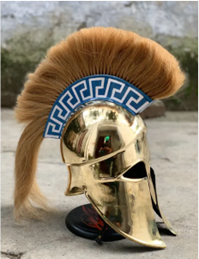
Lastly, I would like to note that even the physical image of a Spartan is misleading. Many of you, when picturing a Spartan, picture the helmet below, often seen in movies and artwork. The problem is that this is a Corinthian helmet from the state of Corinth, which the Spartans merely adopted.
But what about the Spartan military? That is, after all, what they were known for. At the famous Battle of Marathon, the Greeks fought against the same Persians that the famous three hundred Spartans would later fight against at Thermopylae. However, at Marathon, the Spartans sat the battle out, stating they couldn’t fight because it was a religious holiday. However, Marathon and Thermopylae happened during the exact same holiday. Historian Philip Matis says this of the Battle of Marathon:
Ideally, what would suit the Spartans best was for the Athenians to fight the Persians to a standstill on their own and for both sides to get severely mauled in the fracas. Then the Spartans could bring up their army, take on the Persians while they were licking their wounds and hopefully defeat them. Therefore, the Spartans would appear as the liberators of Greece and their Athenian rivals would be crippled.
Not very honorable for a warrior society.
Perhaps the most shocking decline from power was Sparta’s loss to Thebes and ultimate satrapy to Macedon. In 371 B.C., Sparta found itself losing hegemony over Greece following the Corinthian War. In an effort to reassert that authority, the Spartans marched to war against the Boeotian League, which was led by Thebes which was hardly a military powerhouse. At the Battle of Leuctra, the heavily-outnumbered and less-trained Thebans delivered a decisive defeat to the Spartans, ending their hegemony over the Greek Peninsula once and for all.
Following this defeat, the Spartans retained control over many territories in south-central Greece. In 338 B.C., Philip II of Macedon invaded Greece with the intent to unify the region and push back Persian hegemony. After conquering northern Greece, Philip sent word to Sparta, asking if they should become a friend or foe. “Neither” was the Spartan reply. According to Plutarch, Philip then replied “If I invade Laconia, I shall turn you out,” to which the Spartans famously replied with one word. “if.” To turn someone out means to burn down their city and raze their fields while dispersing or murdering the population; not a threat to take lightly.
The Spartan reply, “if,” sounds suspiciously like the witty retort they used against Xerxes in the beginning of this article. While this response is no doubt very cool, Philip took them at their word. According to Plutarch, “Philip proceeded to invade Laconia, devastate much of it, and eject the Spartans from various parts.” Philip proceeded to strip Sparta of all of their possessions, one by one, until the city had no hold over the Laconian region at all. Philip was assassinated before he could raze Sparta, but his son, Alexander, took that mantle from him. Alexander the Great famously invaded Persia, which was his father’s lifelong goal, not Sparta. During the invasion, the king of Sparta Agis III saw an opportunity to regain territory lost to Philip and thus invaded the city of Megalopolis. Alexander’s commander, Antipater, swiftly challenged the Spartans on the field of battle and slaughtered them. I find it poetic that the mighty warrior society of Sparta was eventually conquered without even fighting a battle. Following the loss at Megalopolis, Sparta came under Macedonian control simply through regional hegemonic pressure. There was never a “Battle of Sparta.” Alexander later recollected that the entire event was “a battle of mice.”
By the time of the Roman Empire, Sparta’s power had long since expired. The Romans easily defeated them at the battles of Nabis, Gythium, and eventually the Siege of Sparta. The Spartan mythos, which has held on for thousands of years, expired in real life with a whimper. After being beaten by a league of other city states, crushed by the Macedonians, and finally extinguished by the Romans, the Spartan name no longer carried any relevance. So what can be said of Sparta today?
It would be unfair and inaccurate to say that the Spartans were weak. They did engage heavily in austerity, war-training, and intensive games of politics. They did defeat Athens in the Peloponnesian War and gained Greek hegemony for hundreds of years. However, it is verifiably untrue that the Spartans were the best of the best. They were not undefeatable and did not engage in ritual self-denial that we think they did. In reality, they loved luxury as much as anyone else, had a severely flawed government, engaged in rampant pederasty and slavery, and ultimately were beaten down on the field of battle numerous times.