
Not Everyone Should be Allowed to Vote.
A few notes before we begin: I strongly recommend reading our article titled The Collapse of American Education before reading this one. That article will heavily inform how you engage with this one.
Secondly, let us be clear that universal suffrage is not the same as women’s suffrage, nor black suffrage. While those movements are a part of universal suffrage, the terms are often incorrectly used interchangeably.
A pastime that I have lately been fascinated by is studying how, and most importantly, why, our forefathers came to believe in things today that we would consider wildly unacceptable or downright moronic. Medicine is a good example; how could our forefathers believe that the human body is regulated by four humors, and that leeching the blood of an already sick man could somehow cure him? The reality is surprisingly more nuanced. People of the past weren’t as stupid as we think, and there were reasons they believed the things they did. The word ‘quarantine’ in English comes from the Italian word Quaranta, meaning forty. It refers to a process that medieval Italian ships would undergo when returning to port if they had sick sailors on board – the ship would stay in port for forty days until any sickness passed. These people had no concept of germ theory, but they knew, simply from experience, that sickness was spread through the air and that releasing infected people into the general population would spread that sickness. This is learned behavior, and they learned it the hard way.
History is replete with examples of this, but the one we will be taking a closer look at today is voting. Voting was a right that, in the past, was heavily restricted only to the most elite members of society. To be entrusted with the right to vote was to be entrusted with the future of a nation, and leaders took that charge very seriously. Therefore, the common man, often being uneducated, was not allowed to participate in the process, and for good reason. Allowing virtually every citizen to vote has been a catastrophic disaster for the United States. We have allowed illiterate, uneducated citizens to hold hostage the world’s largest economy, most powerful military, and a robust intellectual culture. It has decimated the concept of civitas and allowed powerful actors with bad intentions to influence those who cannot think for themselves. To restore the United States, we must seriously consider ending universal suffrage.
To begin, we must note that the concept of mass enfranchisement is not unique in history, though we are taught in schools that American democracy is some sort of sacred and holy modern invention. Voting in one form or another has been around as long as documented history. Evidence of pseudo-democratic theories arise even as early as the neolithic period, where archaeological evidence shows a transition from Alpha-male dominated societies towards more egalitarian tribal structures (though still led by a dominant male). As everyone is taught in middle school civics class, the Athenians are credited with the first democracy over 2,500 years ago. The Romans also maintained a democratic republic over 1,500 years ago, and tribal people in the Americas held comprehensive ‘elections’ to decide who their leader would be for different events like hunting, trading, etc. Even in Medieval Europe, with its backward and archaic form of divine right to rule, voting was still employed in some way. A ‘witan’ was a council of wise men – nobles, philosophers, bishops, and more who would convene to counsel or, in some cases, elect, a king. Harold Godwinson, for example, was elected by a witan in 1066.
The common thread between all of these forms of voting was that not a single one of them allowed full enfranchisement of the general population. In returning to our earlier example, we must think like our ancestors and ask ourselves this most critical question: why did they restrict voting rights? What did they know that we don’t know?
In evaluating why general enfranchisement was never considered, we will naturally stumble upon realizations that our forefathers knew back then that we today are only just learning; the general population does not have the intellectual capacity to vote rationally and thus should not be allowed to do so.
Socrates and Plato were both highly critical of democracy. Socrates believed democracy could be likened to thousands of people aboard a ship, all clamoring for control of the steering. How a ship could then chart a direct line would then be impossible as too many conflicting interests would be present. Furthermore, anyone talented in persuasion could get the ship to do this bidding, despite being unqualified. Plato, in his Five Forms of Government, puts forth a natural flow of different forms of government. This flow is not just what governments ought to be, but also how they naturally shift from one to the other.
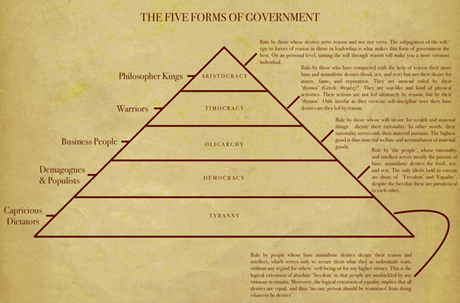
As one can see, Plato considered democracy to be one of the lowest forms of government, just one step above tyranny. He believed that in democracies, in which freedom and equality are maximized, people are led to selfishness and away from the common good. He also believed that this system leads people to vote for what feels good, not what is good. This would inevitably result in the rise of oligarchs, warrior classes, and other unsavory forms of government.
Plato is not the only one who maintained this position. 18th-century historian Alexander Tytler contends that democracies follow a predictable pattern and can only last 200 years in the best of circumstances. He contends that democracies always shift from initial virtue into corruption and subsequent decline. This is because pure democracies functionally rely on the virtue of its citizens, but corruption and rot always overtake the citizenry over time. Like Plato, Tytler believed democracies would always devolve into oligarchies, and that unintelligent and emotional voters would be easily susceptible to corruption and bribery. A few notable quotes from Tytler:
“[in ancient Greece] the patriotic spirit and love of ingenious freedom…became gradually corrupted as the nation advanced in power and splendor.”
“the majority always votes for the candidates promising the most benefits from the public treasury with the result that a democracy always collapses over loose fiscal policy, always followed by a dictatorship.”
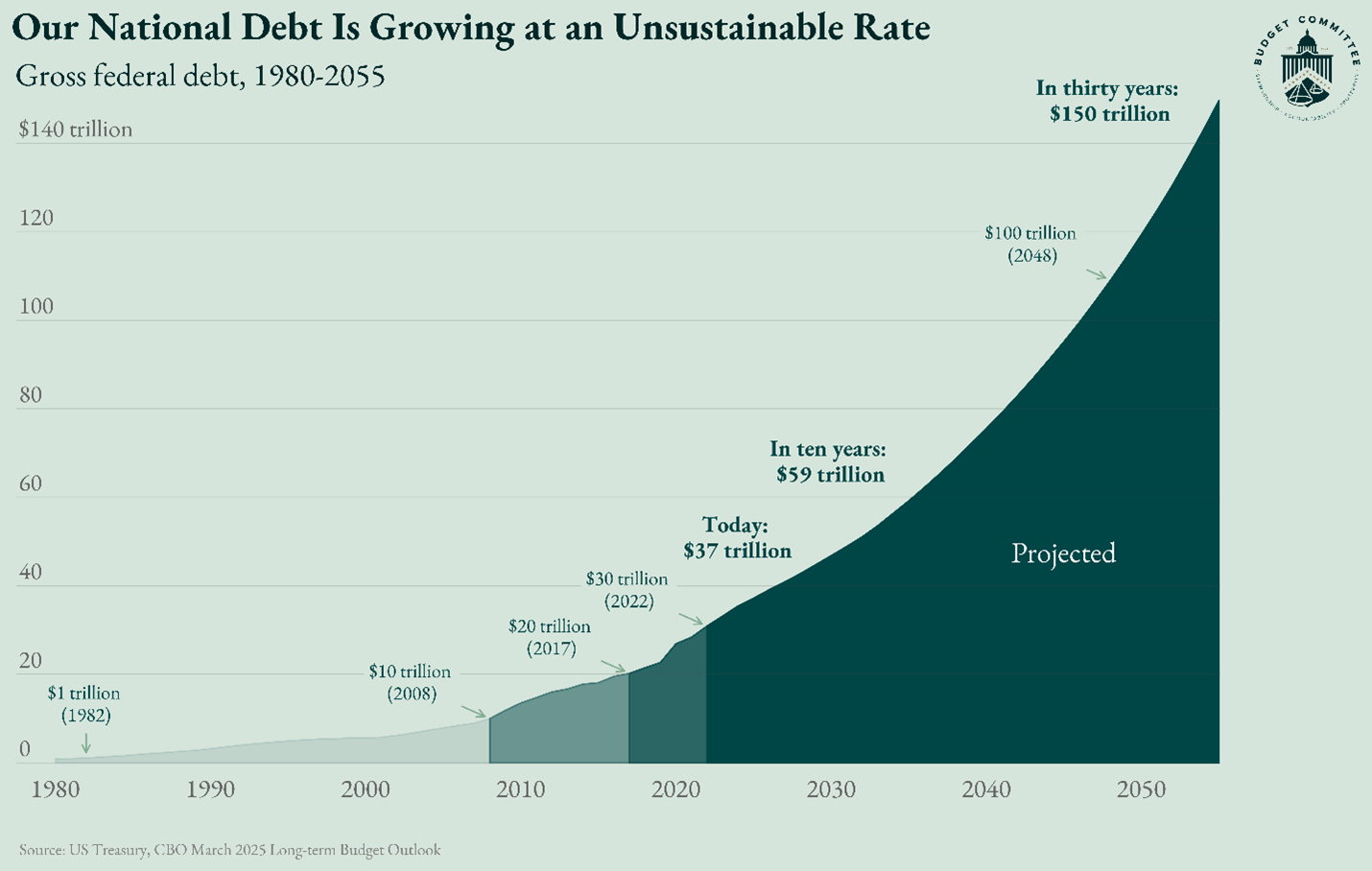
Sound familiar?
The Tytler cycle, as it is known, goes like this: bondage to spiritual faith, to great courage, to liberty, to abundance, to selfishness, to complacency, to apathy, to dependence, back into bondage.
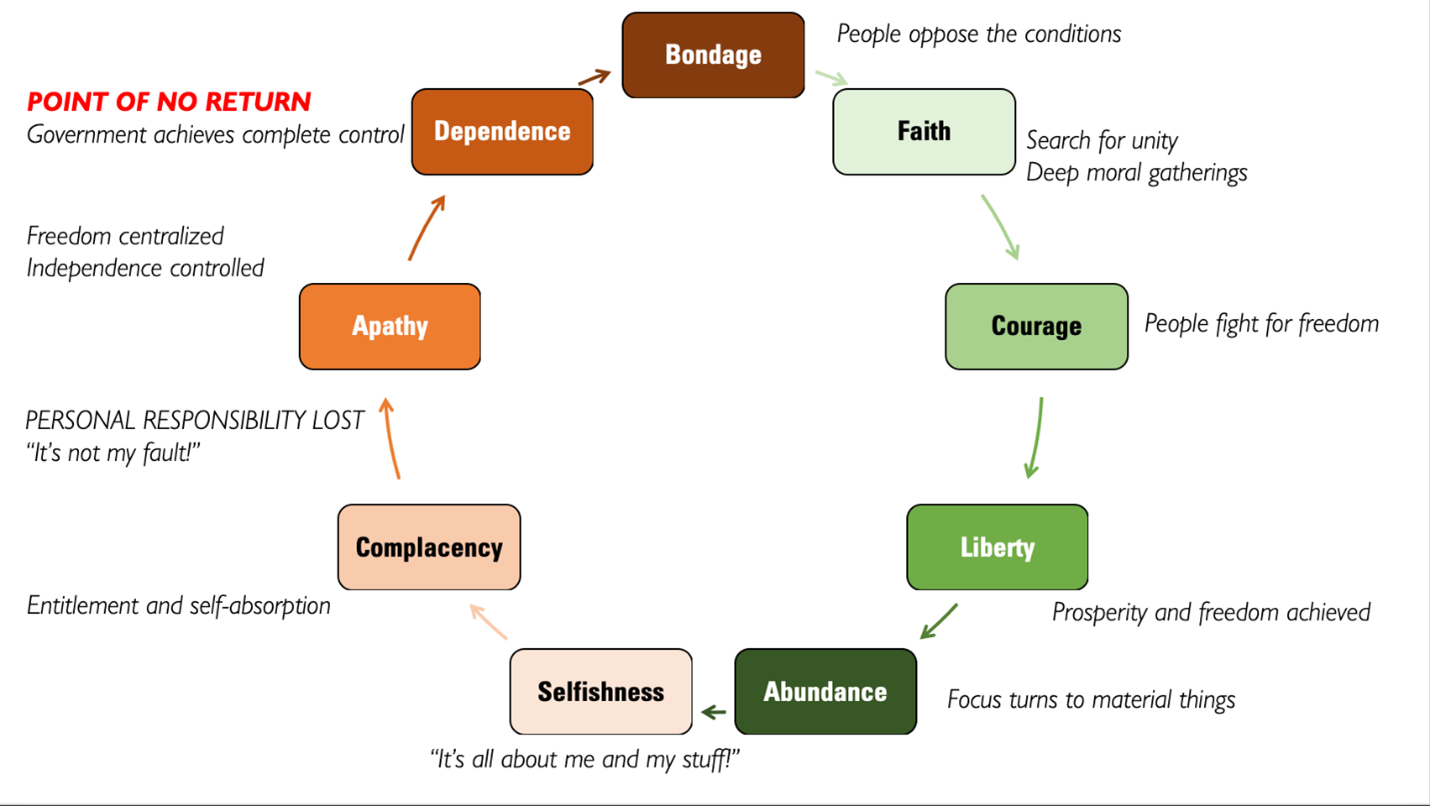
You are somewhere between apathy and dependence.
To be clear, we at American Philosophy do not entirely agree with any philosophy laid out above. We do not view democracy to be the lowest form of government on earth, and the American government has thus far persisted for 250 years, beating Tytler’s limit of 200. We do, however, believe that Plato and Tytler’s fears of how democracies can collapse are entirely valid, and much attention should be paid to faults of this system.
From here on out, I will be drawing heavily upon Thomas Jefferson and the Education of a Citizen, edited by James Gilreath, and the page numbers cited will apply to this book throughout. Jefferson, despite being one of the most brilliant men of the 18th century, was also wrong about many things, and was corrected by his contemporaries. One of his most ardent views was that the general public could be educated to the point of rivaling any great statesman. We will today contend that this is not true and that there are no signs present of any trend in that direction.
Education of the General Public
In the early English tradition, of which all Americans trace their legal lineage, land ownership was a requirement to vote. As we ought to ask ourselves whenever presented with information that seems not to make sense; why? It seems incredibly nonsensical, but, in fact, made quite a lot of sense. In renaissance England, owning land meant owning and understanding virtually all levels of a supply chain. Landowners would have to carefully manage raw material extraction like silver or timber and carefully track labor expenses, shipping, travel, and end-use sales of the commodities that made life possible. Thus, landowners had an intricate knowledge of concepts like percentages, credit, logistics, supply and demand, input costs, revenue, and more. Likewise, landowners at the time were functionally the only ones outside of the clergy who could read. These benefits and more were achievements that the average population could only dream of. If you are a king, why would you allow a parliament to exist based on the votes of people who could not possibly comprehend the most basic tenets of what a kingdom required to function?
The American story is unique because it assumes, and puts into practice, the idea that anyone could become educated at the same level as English landowners and that the hierarchical strata of the Old World need not be. Even this brazen American attempt at undoing an unjust system, however, did not allow full enfranchisement. Voting requirements were originally deferred to the states, but almost always required a man being free, white, and 21. Many states retained land ownership as a qualification. Almost every state had a minimum voting age of 21 by 1868. Section 2 of the Fourteenth Amendment penalized states that restricted the voting rights of male inhabitants who were citizens of at least 21 years of age by reducing the states’ representation in the House of Representatives and Electoral College. The reason that this age was chosen was because English common law, and many Americans at the time, believed that a minimum voting age of 21 was necessary to ensure that voters would possess sufficient independence and sound judgment.
The age of 21 today we consider to be arbitrary. Whether the age should be 18, 21, 25, or 50, is not within the scope of this article. What is not arbitrary, however, is the application of “sufficient independence and sound judgement.” This is likely the single most important concept in this entire essay – voters can only be trusted with the stewardship of the nation if they possess qualities of learned wisdom and the righteous application of said wisdom.
Reason and knowledge were highly touted traits in early America. “The exclusions [for voting] that Jefferson chose to leave in place, minimal property qualifications, 21 years of age, male gender, and sanity, all reflect a concern with the reason and independence of the voter (pg. 58)” This thinking closely followed the works of John Locke who, in his essays Some Thoughts Concerning Education and An Essay Concerning Human Understanding, describes the process of developing reason. Locke notes the processes of reflection and abstracting generalizations from observations to develop complex ideas. He contends that these abilities were essential to participatory citizenship (pg. 51).
Jefferson, with reference to children, says this: “Thus we are born free, as we are born rational; not that we have actually the exercise of either: age, that brings one, brings with it the other too…A child is free by his father’s understanding, which is to govern him til he hath it of his own. (pg. 53).
The ability to reason is critical for robust participation in a democratic system. Without this reason, one is beholden to people who lack any sort of lived wisdom or practical application. Functionally, these are children, and the founding fathers were smart enough to disallow their participation in government. If this sounds lofty and reeks of superiority, please know that it should. We ought to be ruled by our superiors, a topic we will soon come to.
The dangers of being ruled by ignorant men cannot be understated. John Adams says this: “Every kind of useful knowledge will be carefully encouraged and promoted by the rulers of a free state, unless they should happen to be men of ignorance themselves; in which case they and their community will be in danger of sharing the fate of blind guides and their followers.
Jefferson agrees: “Cast your eye over America: who are the men of the most learning, of the most eloquence, most beloved by their countrymen and must trusted and promoted by them? They are those who have been educated among them, and whose manners, morals, and habits, are perfectly homogenous with those of the country.”
To lose adequate education, and to be ruled by the ignorant, is to destroy a nation. In our articles titled The Collapse of American Education and The Decline of American Institutions, we document in real time how this is happening in the United States. A few statistics from those articles: At 24 Illinois public schools, not a single student can read at grade level. 23 Baltimore schools have zero students proficient in math. Nationwide, 54 percent of the American adult population reads at or below a sixth-grade level. At a more broad level, our ability to process information and use reasoning to solve novel problems has been steadily falling since 2010. Likewise, the ability for adults to solve numeracy and literacy tests has also declined. Quite literally, we are becoming dumber.
Uninformed citizens elect ineffective politicians: The last time that congress passed all eight appropriation bills by October 1st, which is the start of the fiscal year, was in 1996. In the House of Representatives, the number of bills introduced has fallen from a peak of 22,000 In 1970 to a paltry 9000 in 2022. Correspondingly, the number of bills introduced per member has also fallen from 50 to 22. For advocates of small government, this may seem like a win. For those who would like to see the legislature legislate, it may contribute to low approval ratings. Most telling is the ratio of bills passed out of the House; In 1950, 23% of bills introduced were passed. In 2022, only 9% were passed. In 1973, there were almost 6,000 committee and subcommittee hearings. By 2022, that number had fallen to 1700.
When uninformed people vote, you get uninformed politicians, just as Tytler predicted. This has real-world effects. Nobody would claim, for example, that farmers should be present in negotiating nuclear radiation protocols. Likewise, nobody would contend that nuclear engineers should lobby for or against agriculture policy. Their areas of expertise do not overlap. This doesn’t make them stupid, but it does mean that they are uninformed about what their representative will actually be expected to do (and capable of doing) in Washington D.C. This is what happens every single day by proxy when people who have a 5th grade reading and mathematics levels are allowed to vote for representation in city councils, state legislatures, and Congress. They are voting for members who represent them, who look like them, who talk like them, and who think like them. A famous example of this is George W. Bush who, famously, was elected by people who thought “well, I’d like to have a beer with the guy.” Inevitably, this results in elected officials who have the same qualifications as their voters. Therefore, we have people who could not pass the most basic citizenship exam electing people who also can’t pass the exam who are in charge of trillions of dollars of GDP, complex nuclear procedures, a massive taxation system, trillions of dollars in mismanaged entitlement programs, the world’s largest military, an Ex-Im bank, the federal reserve, shipping and logistics, tariffs, and more. This is precisely why early English and American common law forbade people with no expertise from participating in these processes. It didn’t work then, and it isn’t working today.
What Now?
That not every citizen should vote is a hard pill to swallow, but it is one that has been present in numerous cultures, including our own. Jefferson once wrote to John Adams:
“For I agree with you that there is a natural aristocracy among men. The grounds of this are virtue and talents…there is also an artificial aristocracy, founded on wealth and birth, without either virtue or talent…the natural aristocracy I consider as the most precious gift of nature, for the instruction, trusts, and government of society…may we not even say, that the form of government is best, which provides the most effectively for the pure selection of these natural aristoi into the offices of government?”
Herein lies the thrust of problem; everyone agrees that our government should be meritocratic, but how can that happen when the voters themselves have few merits? This is where Jefferson errs; he assumes that everyone can be educated to a point of participatory involvement. The United States is unique in that we spend more per capita on education that virtually anywhere in the world and our education is crumbling. If you doubt me, please watchevery single video I have linkedin this sentence and then tell me that these votershave virtue, goodwill, learned wisdom, and are mentally capable of voting in a disciplined way for the common good. If you think I’m cherry picking unfortunate videos that don’t paint a fair picture, please remember that only 36% of American adults can pass a basic citizenship exam. This is not cherry picked info; this is the norm.
Perhaps the most criminal abuse of expanding voting rights to the unqualified is the 26th amendment, which lowered the voting age to 18. This was predominantly done because those under the age of 21 were being drafted to fight in Vietnam but couldn’t vote. Instead of tackling this question logically by raising the age of the draft (or abolishing it altogether), they gave functional children the right to vote. Nixon stated it was a good idea because it would “infuse into this nation some idealism, some courage, some stamina.” The opposite happened. A whopping 66% of voters aged 18-24 vote for the Democrat party today. Interestingly, that number almost halves by the age of 60, showing that as people get older, more educated, and gain more wisdom, they move away from progressive policies. Lowering the voting age to 18 is the functional equivalent of packing the Supreme Court and has had an even more dramatic effect on the country. Without uneducated 18–24-year-olds who entirely lack life experience, it is unlikely the Democrat party would continue to win any national elections. Being beholden to children, as both Locke and Jefferson have stated, is wildly irresponsible.
At this point, you may be wondering what the solution is in fixing this problem. The answer is very simple; it is not age requirements, nor income or IQ tests (though these could suffice as a backup). The simple answer is one we’ve already tried: literacy tests.
Growing up, we are often taught that literacy tests were racist and created to keep black people from voting. Curiously, I cannot recall a single time in my primary education ever being shown an example of a literacy test. I believe that is likely because literacy tests used during the Jim Crow era were so simple that it would have destroyed the narrative of the tests being racist and too difficult to complete. Below is a small sample of the most supposedly racist of the Jim Crow states’, being Louisiana’s, literacy test.
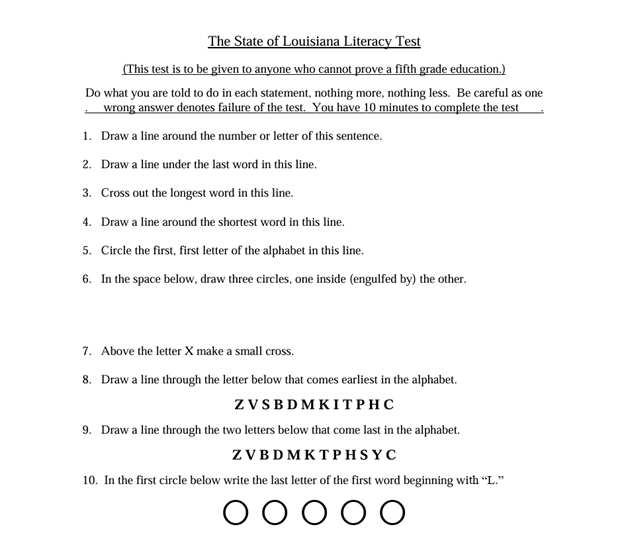
You have to complete it with crayons.
This test was only administered to people who could not show that they attended a public school with at least a fifth grade education – far below what I would consider to be mandatory for voting today.
A more sophisticated example comes from yet again a supposedly backwater, racist state, Alabama.
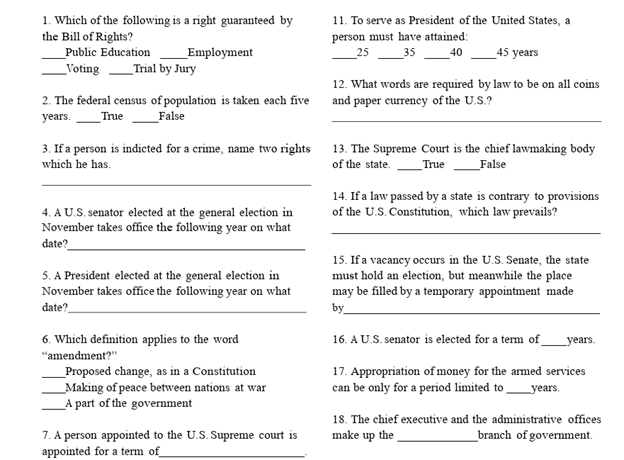
While many people believe literacy tests were created to enforce racism, the same cannot be said today. The above test is fairly rigorous, and I believe many today would fail across all swaths of races. Therefore, if the test doesn’t exclude a certain demographic, it cannot be labeled as racist, and most certainly should be implemented. A modern-day exam ought to prove an advanced understanding of economics, governmental structure, basic math, a high degree of literacy, a robust knowledge of history, and an ability to show clear moral reasoning. Likewise, anyone who takes mind-altering drugs such as SSRI’s, anti-anxiety medications, or anti-depressants, cannot be considered of sound mind, and should be disqualified from voting. Sanity was one of Jefferson’s strictest criteria, something sorely lacking today.
We end near where we began; with Plato’s highest form of government, which are philosopher-kings. In a society where only the people who can pass such a test are allowed to vote, then surely the only people elected to Congress will be those who stand out even amongst the already elite. Plato’s version of a philosopher-king leaves much to be desired; one who is paid simply to lounge about and think all day without laboring or participating in the real world would never make a competent ruler. However, the concept that our rulers should be the most elite among us remains. In practice, the federal government ought to be compromised of extremely virtuous men; ones without any controversy or skeletons in the closet. They should have an advanced understanding of all the things listed in my proposed exam and be able to execute tangible policies with this knowledge. They ought to have labored in their field of expertise for the majority of their career and be a critical expert on it. When elected to Congress or the White House, they ought to serve with the intent to make reforms within their field of expertise and then leave - not hang around for decades. If we are not able to do this, our nation will continue to decline in the death clutches of the ill-informed, emotionally driven mob.