Two-Faced About the Law
Americans have long had a love-hate relationship with law, and this relationship causes immense tension in our day-to-day culture. In our history, the law has simultaneously been an object of great reverence while also being reviled for trampling on individual liberties. Today, this split-brain syndrome is wreaking havoc not only on cultural identities, but also on the implementation of the law itself. The purpose of studying history is to help us chart a path forward; if we don’t know where we have been, it is difficult to know where we are headed. By examining the American relationship with law, we hope to help readers form a firm foundation upon which to analyze future cultural and legal events.
Perhaps no nation on earth has as rich a legal tradition like the United States. As a former English colony, the United States derives much of its legal history from the Magna Carta, which was the first document to enshrine due process of law, individual rights, and most importantly, the position that a king was not immune form the laws of the nation. These values would ultimately form the basis of the United States Constitution and the Bill of Rights. What is unique about the American system of government is that it was intentionally designed, through intensive deliberation during the Constitutional Convention of 1787, rather than originating organically through a common people with shared values and customs. Because of its distance (literally and metaphorically) from Europe, the American legal system was immune from powerful forces like tradition, culture, and custom, which had shackled all prior attempts at legal reform across Europe. American democracy and its associated values of individual liberty and freedoms reverberated throughout the world; It almost immediately began the French revolution, which was one of the most historically significant events in human history, and has directly influenced the legal texts of Venezuela, Ecuador, Mexico, Argentina, Panama, the Philippines, Australia, Japan, Liberia, and even China, to some degree. In fact, the United States Federal Government is so robust that it is today the world's longest functioning government, meaning it has had no coups, interruptions, or changes to its functioning since its inception.
The profound impact of this style of law cannot be understated. It is almost unimaginable today that societies can even function without a legislative body, executive head, and supreme court for judicial review. This style of law has become so ubiquitous across the world that it is difficult to find examples of advanced nations that exist without them. Since 1789, over one thousand laws have been struck down as unconstitutional in the U.S. alone because of our adherence the strict separation of legal and judicial authority – a statistic that would have been unheard of in any nation prior.
Because of this dramatic global impact, citizens of the U.S. have come to almost deify the United States Constitution and the rights that it has enshrined. The United States Capitol Building and Library of Congress are adorned with religious iconography that depicts figures like George Washington attaining apotheosis with the Greek Pantheon of gods. The United States Supreme Court has a massive statue of lady liberty on its grand staircase, depicted similarly to how Zeus or Athena would have been in a Greek temple.
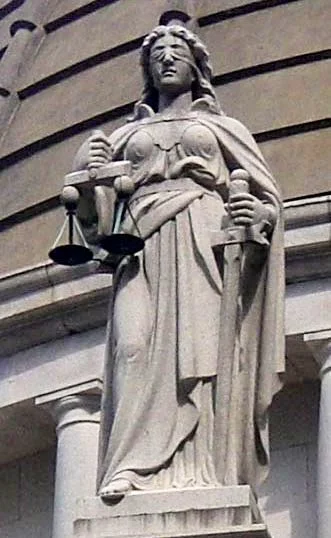
Themis at the Supreme Court
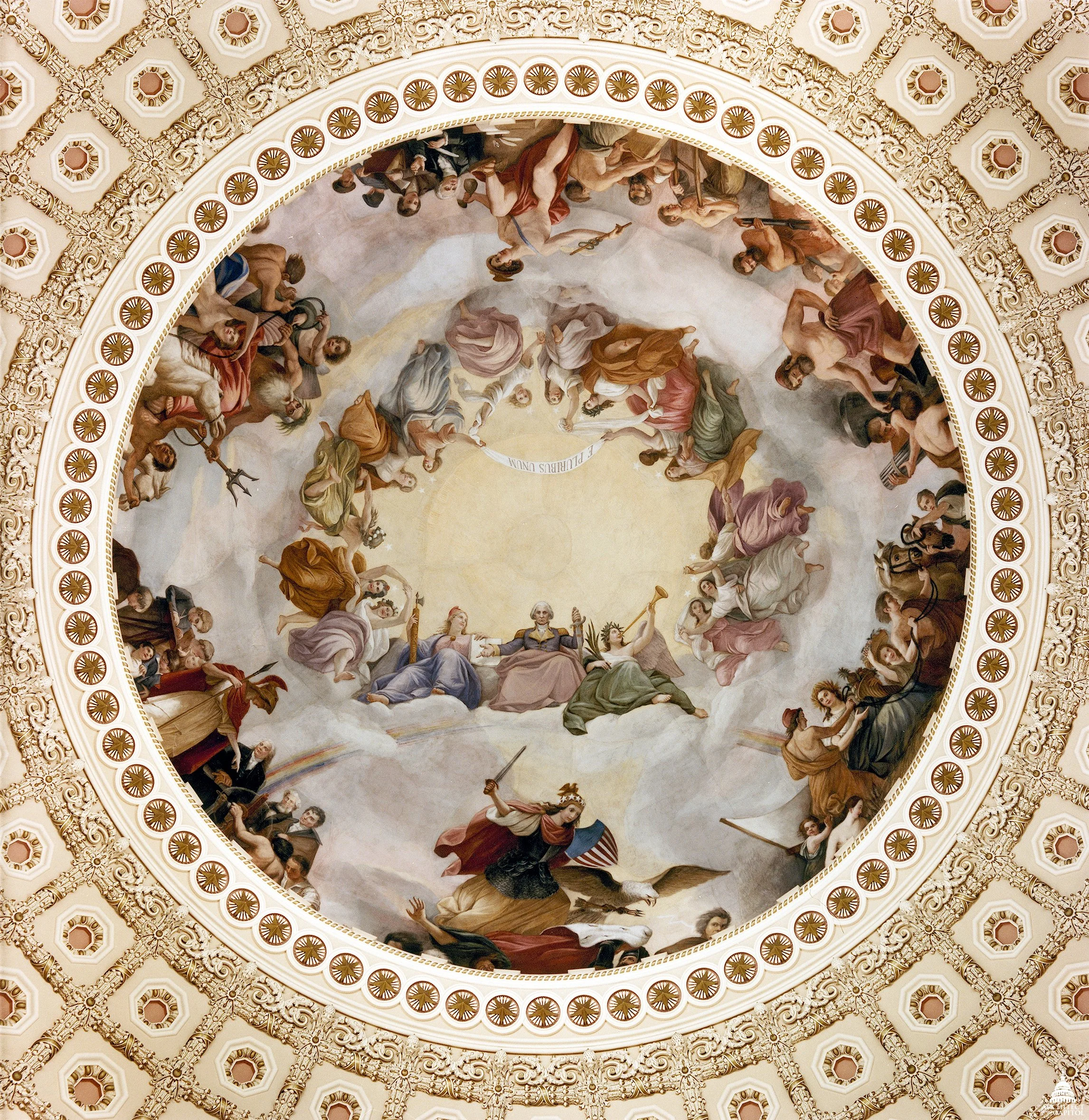
The Apotheosis of Washington
This near deification of the rule of law is so encompassing that many citizens forget that practices such as the Pledge of Allegiance, the maintaining and bearing of arms, and state vs. federal authority are in fact very alien concepts for most of human history. It also makes the review of our own history of rebelling against the law feel like a head on car collision.
Defiance of Law
As Martin Luther King Jr. famously stated, just because something is legal, doesn’t make it right.
Our country’s endless fascination with both lawlessness and opposition to the state seems to fly in the face of everything stated previously. To begin, it would be hypocritical not to recognize that the American revolution itself was an open rebellion against the king of England. We celebrate this rebellion, and rightfully so, but must admit that it is not congruent with a nation committed to such lofty legal ideals. Therein lies one of the most fundamental contradictions of American culture: If adherence to legal procedure is a moral imperative, at what point does defiance of legal procedure also become a moral imperative?
This question plagued the Constitution’s authors and subsequent generations through to the modern day. The most obvious example of this conundrum lies in the Second Amendment to the Constitution, which reads “A well regulated Militia, being necessary to the security of a free State, the right of the people to keep and bear Arms, shall not be infringed.” It should be noted that being an amendment to the constitution means it was not included in the document originally. The Bill of Rights is a list of 10 amendments that anti-federalist states required before they would ratify the constitution as they were concerned about a central federal authority usurping individual and states’ rights. The implication of the addition of the second amendment is profound; the federalists had constructed a robust legal document that served as a foundation for all legal and political proceedings, but the anti-federalists were concerned that the law might be used to enact unjust actions. Therefore, this amendment explicitly acknowledges that threats to liberty may be allowed or even committed by the state. Both the Pennsylvania and Massachusetts state charter acknowledge that standing armies are a threat to liberty, and the common people must be armed to counter that threat. The thinking goes, as we mentioned above, that just because something is legal, doesn’t make it right, and the anti-federalists were prepared to take up arms against the state in their own defense.
American history is riddled with powerful examples of those who defied the law for the moral good. The American tea party is a good example, as are the numerous actions the revolutionaries took in response to the Intolerable Acts. Internationally, we recognize many figures who embody this spirit, from the Tiananmen Square Tank Man to Nelson Mandela.
For a nation so utterly obsessed with the law, we sure do love our outlaws.
Cultural Impact
This seemingly contradictory set of beliefs has intrigued our nation for quite some time. In 1866, famous outlaw Jesse James began his robbery spree that would last over ten years and directly culminate in the deaths of roughly 20 people. Despite stealing nearly a quarter of a million dollars, an extremely popular dime novel series was created not twenty years after his death that portrayed James as a pseudo-Robin Hood; a sort of charismatic outlaw that intended to do good despite his circumstances. He was, and is, wildly popular when viewed this way, despite the fact that he held no regard for the law.
Contrarily, around this same time period, one of the most hated men in America was in his heyday. Jay Gould, one of the most infamous robber-barons of all time, made his fortune ($72 million at the time, equivalent to $2.5 billion today) through all sorts of nefarious, but legal, means. Gould manipulated stocks, tried to corner the gold market, built railroads where others couldn’t, and ruthlessly cornered the telegraph market. Despite all of this being legal at the time, the public hated him. Mark Twain is quoted as saying “[Gould] is the mightiest disaster that has ever befallen this country.” In 1873, an investor assaulted Gould at a public event and the New York Times stated the “flattening of Gould’s nose” might be “an hourly occurrence.” Jesse James, a clear criminal, thief, and murderer was idolized by the public and the same time that Jay Gould was loathed, despite following the letter of the law.
Johnny Cash, known for his problems with drug addiction and for his songs about murder, was also one of America’s most beloved musical artists. He performed a shocking thirty performances at prisons across the country for convicted felons. In fact, he became the face of what is known as outlaw country music. Interestingly, rap and hip-hop music is generally disliked among Americans for similar themes of drug use, murder, and other actions that are against the law.
Curious contradictions indeed.
Today’s Impact
As I write, numerous individuals have taken to torching Tesla vehicle lots to protest Elon Musk’s involvement in remaking the federal government. To them, this is a morally righteous action taken against a tyrannical government. To his supporters, this is domestic terrorism. On January 6th, 2021, thousands of protestors stormed the U.S. Capitol building to fight against what they perceived to be a stolen election. To their supporters, this was a morally righteous action taken against a tyrannical government. To their enemies, this was domestic terrorism. In 2020, thousands of protestors burned billions of dollars’ worth of private property in cities all across America to protest the death of George Floyd. To their supporters, this was a morally righteous action taken against a tyrannical government. To their enemies, this was domestic terrorism.
As is likely clear by now, whether or not an action is viewed as morally permissible or heinous and illegal is entirely dependent on the perspective of whoever is viewing the action. While this may not be a revelatory conclusion, it important is to notice the effect it is having on our society. Both progressives and conservatives have outlaws that they idolize while demeaning their opponents for behavior that these opponents hold in the same regard. Progressives view violence against immoral actions as a necessary step for social justice, equal to anti-slavery movements, the civil rights movement, feminist waves, and more. Conservatives view violence to be in line with the foundation of the country and the revolt against governmental tyranny.
Ironically, many people at once proclaim that the Tesla firebombings and other actions, like the slaying of United Healthcare CEO Brian Thompson, to be morally permissible if illegal, while at the same time supporting lawsuits against Donald Trump on multiple counts of what they believe to be unconstitutional actions taken in the White House. It ought to be clear that in a highly polarized climate, the law is simply a bludgeon used to condemn actions that a culture simply doesn’t like.
It is not advisable, for long term stability, to at once champion and vilify the law based on personal whims. This behavior dilutes the law and encourages extra-judicial behavior done in the name of moral righteousness. For long term stability, we must be consistent: Are we a nation or lawmen, or of outlaws?