Has ‘Big Business’ Gone Too Far?
The foundational story of the United States is another chapter in the tale of consolidated power against the people. Against all odds, those with seemingly no power were able to stand up to the British Empire and cement their ability to freely express themselves and conduct their behavior in a way they deemed to be appropriate. To protect from consolidated power via governmental authority, the Constitution and Bill of Rights were authored. These ensure that the rights of people, including the rights of those in the political minority, would be protected regardless of the ruling power or party.
What is often overlooked in our foundational story is that the founding fathers didn’t see government as the only threat to individual liberty. Instead, they were more concerned with consolidated power that threatened individual liberties in any capacity. For example, Federalist Paper No. 10, by James Madison, explicitly states that a direct democracy, one in which every person votes directly on national matters, would be a threat to individual liberty. While authoritarian tyranny and mob rule are the most common threats to the individual, there are other ways for power to consolidate and tread on individual rights.
‘Big business’ is one of these ways. Thomas Jefferson, author of the Declaration of Independence, noted in 1809 that “the selfish spirit of commerce knows no country, and feels no passion or principle but that of gain.” In 1816, he stated that “we shall crush… in its birth the aristocracy of our moneyed corporations, which dare already to challenge our government to a trial of strength and bid defiance to the laws of our country.” Throughout the following decades, the United States would go back and forth on what the proper role of major corporations should be in America. By the early 19th century, large corporations and big banks had entered what is now called the ‘gilded age,’ a time plagued by robber barons and monopolization. In 1890, the richest 9% of Americans held 75% of the nation’s wealth. Before the century was over, Teddy Roosevelt would pass the famous Sherman Antitrust Law, pitting himself against numerous major corporations, including Northern Securities owned by J.P. Morgan. However, government power over corporations was not a one-way street. Just over 100 years later, J.P. Morgan (the bank) would end up being bailed out by the government to the tune of $25 billion dollars by becoming, what we call today, “too big to fail.”
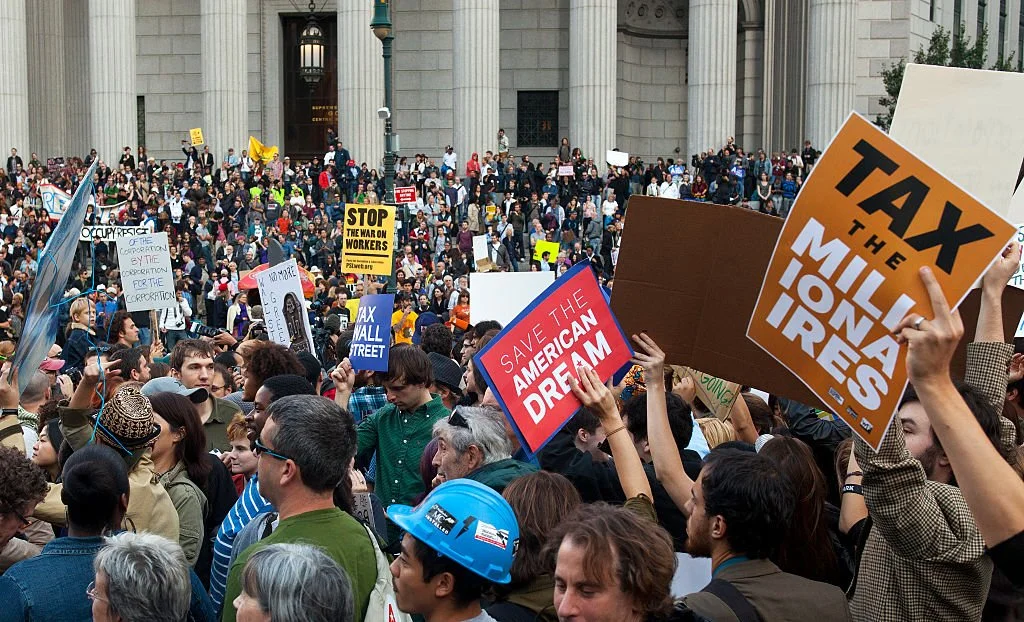
Progressives in the United States have been the bane of corporations since Teddy Roosevelt and have often been the driving force behind many major reforms. From trust-busting to OSHA standards, the far left has been the ever-present thorn in the side of ruthless big business. After being crushed by Roosevelt’s anti-trust legislation, major corporations learned to lean into their enemies instead of fighting them. In 2011, the Occupy Wall Street movement became the most recent example of this relationship when protestors camped out in New York’s Wall Street District to protest income inequality, campaign finance law, and more. This brazen display of defiance by the people forced the powerful corporations on wall street to change…nothing. There were no significant reforms that came out of this movement.
Except for one. Fast forward just 12 short years and we find that Marxists and the radical left are now the largest proponents of mega corporations in the country. Apple, Starbucks, CNN, Facebook, Twitter, Netflix, Amazon, Microsoft, Alphabet and more are staples of leftist ideology. They create content and products that radically shift the social agenda toward leftist priorities. They have dumped billions of dollars into campaigns, commercials, super bowl shows, online ads, and more intended to sway public opinion. But how did corporations go from the enemy to the darling of the Marxist left in such a short time?
So-called world changers.
J.P. Morgan, the same lineage of which Teddy Roosevelt trust-busted and which was bailed out by the federal government, has the perfect answer. They have wholly embraced the far left by encouraging Marxist behavior, participating in very visible LGBT events, and cutting ties with conservative groups. Publicly, this makes them very difficult for the left to attack. Behind the scenes, however, Chase Bank’s (owned by J.P. Morgan) PAC was one of 25 corporations that collectively spent more than $10 million since 2019 to back members of Congress who are in support of anti-LGBTQ legislation. They also contributed $275,000 to federal lawmakers who had earned a "0" rating from the Human Rights Campaign, a leading LGBTQ advocacy organization. Chase also donated $2,500 to sponsors of anti-trans legislation in five US states. Currently, there have been no protests or acknowledgement of this discrepancy from the left while Chase continues to profit from what is essentially a marketing ploy disguised as sincere cultural concern.
The raw corporate accumulation of wealth in and of itself is not as much of a concern as what that wealth is used for. Today, corporations are spending massive resources to influence culture and public opinion in exchange for increased business. According to Harvard Business Review, 60% of companies have a Diversity, Equity, and Inclusion (DEI) strategy, 66% have a DEI budget, 73% have a commitment to DEI incorporated into their company values, 40% have a senior leader fully dedicated to DEI, and 63% have partnerships with organizations focused on DEI. Likewise, inflows into sustainable funds (including primarily environmental anti-fossil fuel investing) rose from $5 billion in 2018 to $70 billion in 2021, despite the fact that green tech provides very little, if any, fiduciary benefit to a company. A study from Reclaim Finance found that 30 leading asset managers—25 of whom were members of the Net Zero Asset Managers initiative at the time—still hold a combined $550 billion in coal, oil, and gas companies with new projects planned.
Regardless of how one feels about DEI initiatives themselves, it is not controversial to say that socio-cultural movements have contributed strongly to the hyper-partisan breakdown of our communities and our nation as a whole. Therefore, this clear public relations stunt – one which the company doesn’t truly believe in beyond the potential for increased profits – is clearly intended to control and drive a public narrative. I encourage the reader to consider what effect this behavior has on society as whole. When billions upon billions of dollars across every sector of the economy are poured into divisive socio-cultural issues all for nothing more than profit, we are certain to find serious ramifications for our culture and overall happiness.
Since 2019, the percent of people who say banks have a positive effect on the way the country is heading has dropped from 63 to 38 percent among Republicans. The view on large corporations as a whole has also dropped from 54 to 24 percent. In 2019, identical shares of Democrats and Republicans (58% each) said technology companies had a positive effect on the country. While Democrats’ views are unchanged, the share of Republicans with a positive view had fallen 20 percentage points by 2021.

No agenda, just fashion. For kids.
Major corporations have won the battle against the left by embracing their ideals without changing their core behavior. They have entirely swallowed their Marxist opposition and, in so doing, have been left unchecked to pursue and exacerbate cultural strife. Big business has distracted their main opposition so successfully that they are now able to do what Thomas Jefferson feared – rival the government in which institution can more effectively destroy individualism. What Jefferson never could have comprehended, however, was that big business could actually combine with big government.
Facebook, which has over 3 billion monthly active users, has stated that the Biden Administration routinely pressured them to censor COVID-19 information, to which they agreed to do so. In fact, Facebook’s fact-checking program had become so draconian that CEO Mark Zuckerberg scrapped the program in 2025, saying it had done “too much harm.” Likewise, the House Committee on Oversight conducted a two-year investigation into social media censorship and concluded that Twitter coordinated extensively with the FBI to disproportionately target Republican leaders, conservative activists, and certain media outlets. In October 2020, Twitter censored the New York Post’s story about the Biden family’s business schemes based on the contents of Hunter Biden’s laptop, despite the article not violating any Twitter policies. Not only are these companies worth billions of dollars, they also have more social outreach than virtually any other industry with functionally zero viable competitors.
This amount of influence has had serious ramifications. On top of the socio-cultural divide mentioned before, it has also shaped political elections, eroded trust and faith in our institutions, and fundamentally sowed mistrust in the media and in our fellow Americans. As expected, it was, once again, all for show.
Zuckerberg’s abolition of the fact-checking program did not come until Donald Trump won the White House for the second time. This election made it clear that progressive policies were no longer popular or profitable, and a litany of companies dropping their DEI programs followed quickly. Within a month of Trump’s election, hundreds of companies removed internal DEI requirements including Citigroup, Pepsi, Coca-Cola, Goldman Sachs, Disney, Deloitte, PBS and, you guessed it, JP Morgan Chase.
Driving a wedge between the two factions in our country for profit is a dangerous way to conduct business. As Jefferson said, companies have no allegiance to country except money, and have demonstrated they will destroy our social fabric in its pursuit. This conglomeration of power threatens not only individual liberties, but also social cohesion and overall happiness. It would be wise for the general public to consider very carefully what a business’s intent is when it engages in these type of actions. By asking ourselves why a company would do this in the first place, we might be able to alter this behavior in the long run.